Table of Contents

Meta Conversions for Retail: 6 Use Cases Brij Unlocks

- Brij sends retail, marketplace, and offline purchase signals into Meta via the Conversions API, enabling attribution and optimization beyond website-only conversions inside Meta Ads Manager.
- Brij captures first-party identity through QR code and link-powered experiences, improving Meta match rates, strengthening retargeting audiences, and increasing the value of mid-funnel website events.
- Brij event streams support Meta audience creation, including retargeting, lookalike modeling, suppression, and retail-specific optimization pilots using dedicated custom conversion events.
- Manual CSV uploads of Brij customer lists provide a low-engineering pilot path for Meta Custom Audiences, but long-term performance requires always-on event integrations for fresher signals.
Retail and omnichannel brands have the same recurring problem: your best customers don’t always convert on your website. For marketers, that's an issue because only website conversions are reported in paid media platforms.
It goes like this: they discover you on Instagram, they buy on Amazon, or they grab you at Target. And your paid social team is left in the dark.
Brij helps close that gap by capturing retail identity and conversion signals through QR or link-powered experiences, then activating those signals inside Meta to improve reporting, audiences, and optimization.
Brij’s approach aligns with how modern brands already use post-purchase engagement (registrations, rebates, sweepstakes, content unlocks) to turn anonymous retail transactions into owned customer relationships.
Below are six Meta use cases Brij supports, and advice on when these work best.
Meta Conversions vs. Meta Omni Ads
Meta Conversions is a Brij capability.
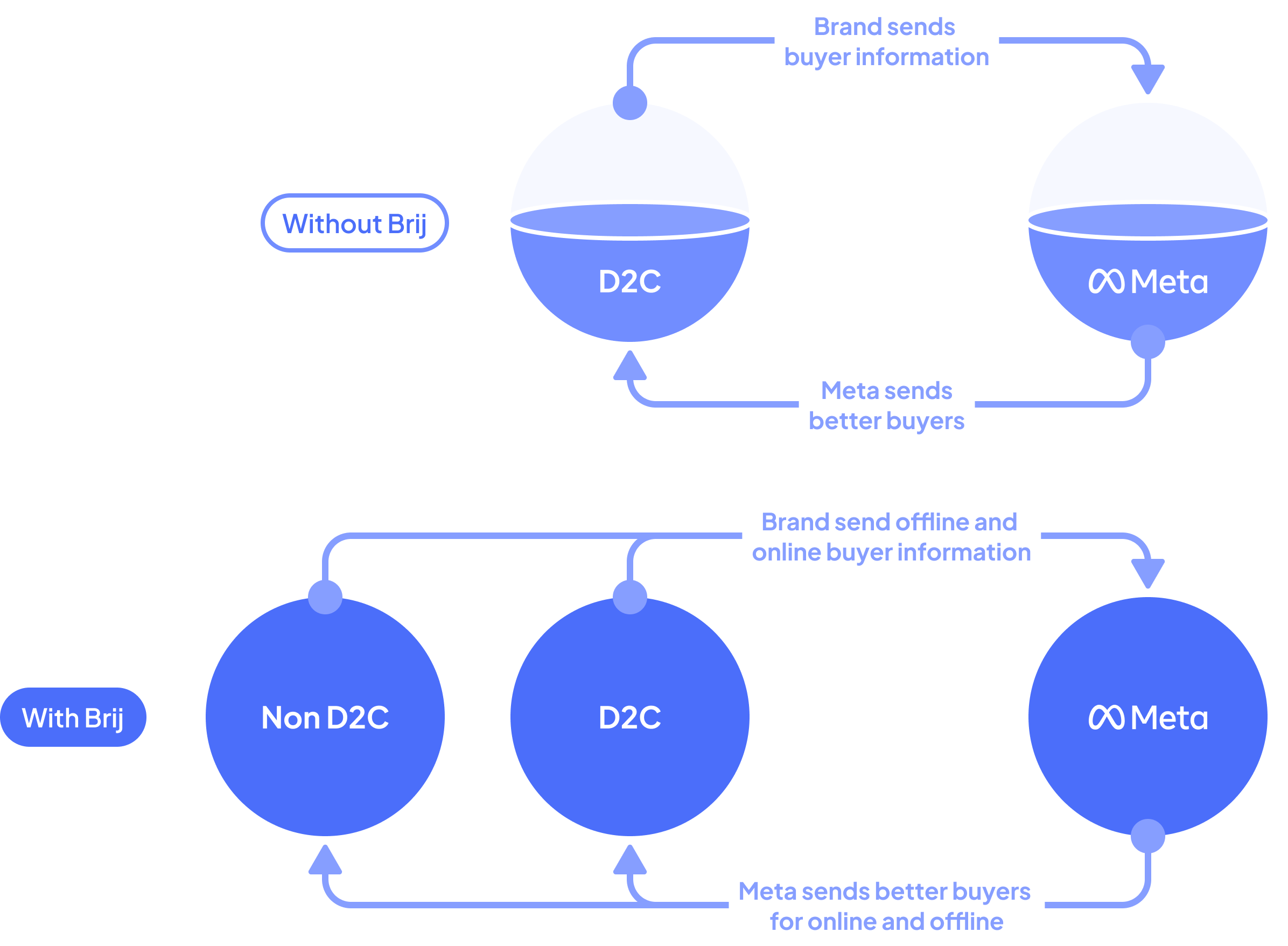
Brij sends non-DTC purchase events (retail, marketplace, offline) into Meta via the Conversions API, so retail performance becomes visible and usable inside Meta Ads Manager.
Meta Omni Ads is a Meta program.
Some larger brands may be eligible to run omnichannel optimization inside Meta (online + offline). Eligibility and availability are controlled by Meta. Brij can power Omni Ads if the account is eligible, but Brij does not guarantee access.
The Value of Meta Conversions
Even if a brand isn’t eligible for Meta Omni Ads, integrating Brij with Meta still delivers meaningful value today. By sending Brij-captured retail and engagement signals into Meta, brands improve attribution, strengthen retargeting audiences, and give Meta’s algorithm more accurate buyer signals, without changing their core campaign structure.
The result is clearer performance insight inside Meta Ads Manager, better audience quality, and smarter optimization based on how customers actually buy across retail and non-DTC channels.
Use Case 1: Send Brij Offline Purchases to Meta (Offline Conversions / Omnichannel-ready)
What It Is
Brij sends Brij-captured retail purchase signals into Meta as offline purchase events.
Why It Matters
With offline events, you often have less data per purchase, and you rarely capture 100% of buyers. Meta expects offline capture to be incomplete, so the model can still learn from the share of transactions you can match.
Offline purchase events are evaluated differently from website conversions inside Meta. They’re designed for real-world buying behavior, making Brij a natural fit for retail measurement and omnichannel optimization.
How It Works with Brij
A customer scans your QR code or clicks a digital link, completes a Brij flow (registration, rebate, sweepstakes, etc.), and Brij sends the corresponding purchase event into Meta via CAPI, so Meta can attribute and optimize beyond DTC-only outcomes.
Brij doesn’t need to capture every retail purchase; just enough verified signals for Meta to model total performance and optimize more effectively.
Best For
Brands that want omnichannel visibility and improved Meta performance without reworking their entire stack.
Use Case 2: Identity Bridging for Better Website Retargeting (Brand Pixel/CAPI on Brij)
What It Is
A brand connects its Meta Pixel and/or CAPI to Brij. When someone converts on a Brij experience (register/redeem/purchase), Brij sends Meta events with hashed identifiers (when available). Later, when that person visits your website, Meta is more likely to recognize them, improving retargeting and audience addressability.
Why It Matters
Most brands only learn who a visitor is at checkout. Brij introduces identity earlier, so actions like View Content, Add To Cart, and Initiate Checkout become more usable for retargeting. The value here is efficiency: stronger match rates often translate into cleaner retargeting pools and better delivery.
Without identity, many website interactions are effectively anonymous to Meta. Brij helps introduce matchable identity earlier, so common mid-funnel actions become more usable for retargeting and audience building.
Why Brij Is a Natural Fit
Brij experiences are designed to capture first-party data through high-intent moments (post-purchase, rebates, sweepstakes, registrations), then sync it into the rest of your stack.
The earlier Meta can associate real identity with a shopper, the more valuable every downstream website event becomes. Brij helps close that identity gap before checkout.
Use Case 3: Build Meta Audiences From Brij Events (Retargeting + Lookalikes + Suppression)
What It Is
Use Brij event streams to create Meta audiences such as:
- Retargeting: people who engaged, registered, redeemed, or purchased (via Brij)
- Lookalikes: prospecting based on proven retail buyers
- Suppression: exclude recent registrants/purchasers (when it fits your strategy)
Meta’s audience tools prioritize signal quality over perfect coverage. Brij events represent verified, high-intent customers, making them strong inputs for retargeting and lookalike modeling even at a smaller scale.
Why It Matters
Audiences are one of the fastest ways to activate retail signals in Meta because you don’t need perfect coverage. High-intent retail engagement often matters more than volume. Even partial capture can produce a high-intent seed list for retargeting and lookalikes.
Where It Works Best
This is a low-friction, low-risk performance lever for brands running awareness-to-retail strategies or marketplace-heavy growth.
Use Case 4: Send Custom Brij Conversion Events (Retail-Specific Optimization Pilots)
What It Is
Create a dedicated event (e.g., “Brij Retail Purchase” or “Brij Registration”) and run Meta campaigns optimized toward that event.
Because these events reflect a subset of total retail buyers, they’re best used as a directional optimization signal, not a full replacement for higher-volume conversion events.
Why It Matters
This approach keeps reporting clean: you’re optimizing to a retail-specific outcome without blending into your core DTC “Purchase” signal.
How to Position It
This is best treated as a controlled pilot, especially for retail-first brands that don’t have a strong DTC purchase signal to optimize against.
Optimizing toward a retail-specific signal works best when expectations match reality – lower volume, clearer attribution, and controlled testing rather than broad replacement of core purchase campaigns.
Use Case 5: Send Brij Events as “Online Purchase” (Special Cases Only)
What It Is
Treat Brij conversions as standard “Purchase” events and merge them into the same purchase signal your website already uses.
Meta’s optimization systems rely on consistent, comparable signals. Mixing fundamentally different purchase sources can make performance harder to diagnose, even if total event volume increases.
When It Can Make Sense
In specific scenarios, teams may want to expand the buyer pool for optimization without building new campaigns.
Why It’s Not the Default
Most brands want a clean, dependable core purchase signal. Blending multiple sources can make it harder to isolate impact and keep tracking interpretation simple.
Recommendation
Consider this only when you have a clear measurement plan and a reason to merge signals.
Use Case 6: Manual Variant — Upload Brij Customer Lists (CSV → Meta Custom Audiences)
What It Is
Export Brij customer lists (emails/phones) and upload them to Meta to create custom audiences.
Why It Matters
Manual uploads are the fastest pilot path with minimal engineering, and a strong way to prove audience value before enabling real-time event streams.
This approach is best viewed as a stepping stone: useful for testing audience impact before investing in real-time event integrations that continuously improve performance.
Tradeoff
It’s not scalable long-term. Long-term performance requires always-on signals as customers keep buying. The audience is only as fresh as your most recent upload.
Conclusion: Make Meta Smarter About How Your Customers Actually Buy
Your Meta ads shouldn’t optimize for a world where every purchase happens on your website.
Brij helps retail and omnichannel brands translate real customer outcomes – registrations, rebates, sweepstakes participation, and retail conversions – into Meta-native signals that improve attribution and performance where it matters: inside Meta Ads Manager.
Interested in learning more about how Meta Conversions might work for your brand? Talk to our team here.
.png)