Table of Contents

How to Use the Brij AI Analytics Agent to Generate SKU-Level Customer Reports

- Brij enables retail brands to collect structured, SKU-level first-party data through receipts, surveys, and post-purchase experiences, including customer demographics, discovery channels, purchase motivations, and retailer information tied to individual products.
- The Brij AI Analytics Agent can aggregate survey and form responses across modules and convert raw datasets into structured summaries, eliminating manual exports and time-intensive reporting workflows
- Brands can also use the AI Analytics Agent to generate SKU-level buyer profiles that reveal demographic differences, discovery channels, and purchase motivations for each product, enabling clear “average customer by SKU” analysis.
- PackIt used the Brij AI Analytics Agent to analyze years of survey data and identify product-specific audience profiles, purchase drivers, and retail discovery patterns across major retailers.
If you’re a brand using Brij, you are sitting on something most retail brands don’t have.
You know who your customers are. Brij brands have the capability to gather and analyze data not just on what sold, but:
- Who bought it
- Their age and gender
- Household composition
- Where they discovered the product
- Why they chose it
- Which retailer they purchased from
Whether that data comes from Brij receipt analytics, surveys, or other post-purchase experiences, you are collecting structured, SKU-level, first-party data that simply does not exist for most brands selling through retail or marketplaces.
Once you capture this data, Brij lets you easily activate it by syncing with your CRM, triggering flows, and segmenting audiences. But, there’s another layer of value sitting inside that data: executive-ready intelligence.
This is the kind of report that tells your leadership team exactly who is buying each product, what drove their purchase, and how they found you – broken down by SKU.
If you have multiple forms, multiple SKUs, and multiple retailers, pulling everything together into a clean "average customer by product" report can take hours, sometimes days.
With the Brij AI Analytics Agent, it doesn't have to.
How PackIt Turned Years of Data into SKU-Level Intelligence
To understand what this looks like in practice, let's look at a real-world example from PackIt.
As a Brij customer for over three years, PackIt has built a powerful retail data capture engine using QR codes on product tags to drive customers to surveys, collecting valuable first-party data in exchange for a discount incentive across major retailers, including Walmart, Target, Dick's Sporting Goods, and Office Depot.
With 17 different forms and surveys across its product-specific modules, PackIt had years of rich data from thousands of customers across its entire product line.
The team wanted to answer one major question: Who is the average buyer for each of our products?
The goal was to create a profile of the average customer for each SKU. Historically, that meant:
- Exporting responses from every module individually
- Consolidating them into a single spreadsheet
- Building summary tables and charts manually
- Repeating the entire process for each SKU
Using the Brij AI Analytics Agent, PackIt was able to transform this raw data into clear, actionable audience profiles for the first time. Here's how.
Step 1: Centralize the Data Instantly
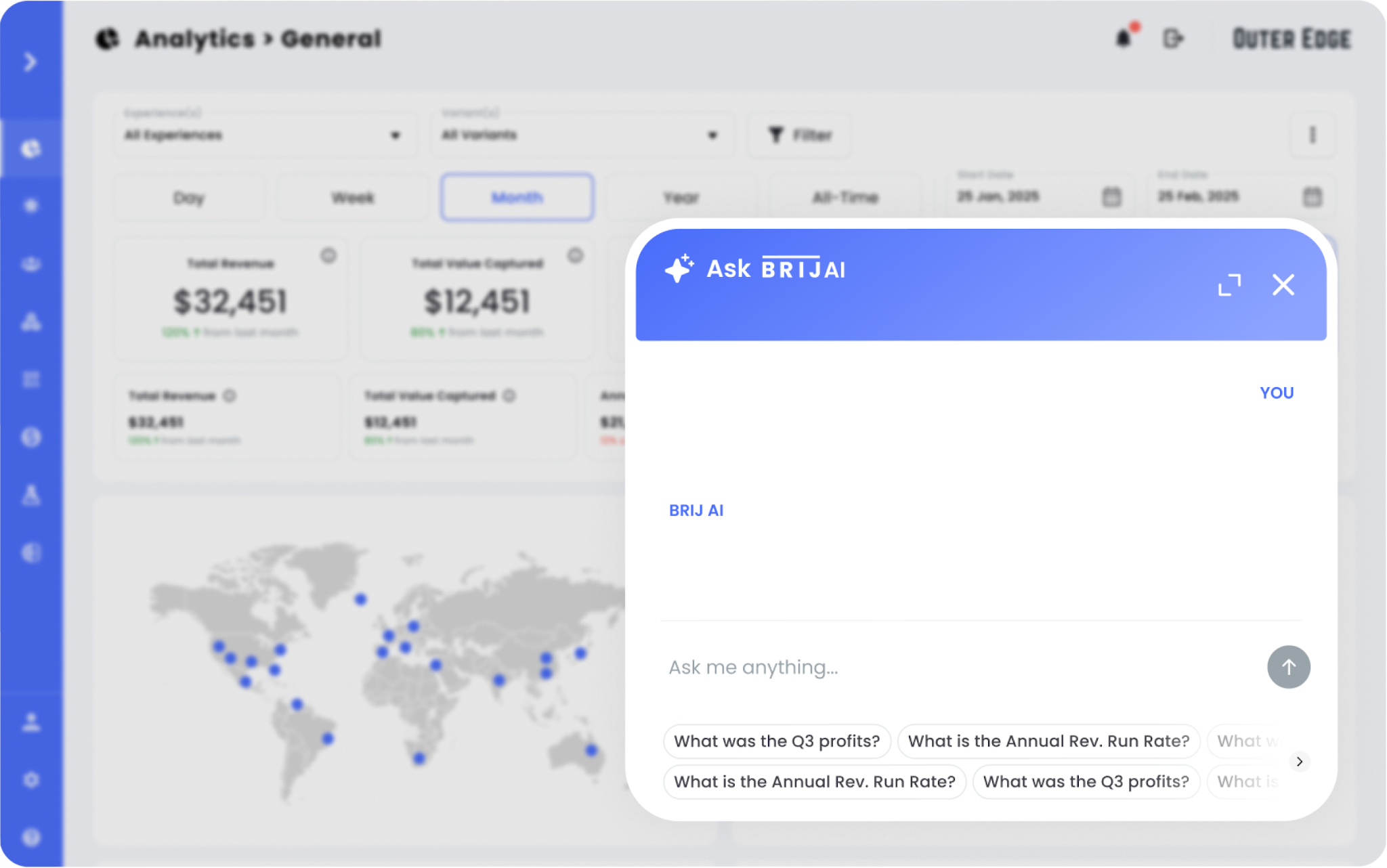
Inside Brij, the AI Analytics Agent can access survey responses across all modules simultaneously. Instead of exporting 17 separate datasets, you can simply prompt:
"Summarize the demographic profile for each product based on survey responses."
The AI aggregates all of the data you're collecting across your forms and, in seconds, you move from raw responses to structured summaries. This alone replaces hours of manual compilation.
Step 2: Generate SKU-Level Buyer Profiles
The real power comes when you ask the AI Analytics Bot to structure insights by product. For example:
"Create an average buyer profile for each SKU."
The AI breaks down:
- Who buys Product A vs. Product B
- Where they discovered it
- What motivated the purchase
- How demographic skews differ across SKUs
That entire process collapses into a single conversation.
Step 3: Prepare Executive-Ready Outputs
From there, brands can take AI-generated summaries and pair them with a third-party visualization tool to create clean, presentation-ready outputs -- bar charts, demographic visuals, purchase driver comparisons, discovery channel breakdowns, and product-by-product slides.
This is exactly how PackIt generated a deck showing:
- Response volume by SKU
- Clear age and gender skews across its product line
- Household patterns tied to specific products
- Top purchase drivers by SKU
- Retail discovery variation across its assortment
Without hiring a research firm and without weeks of analysis, they had critical intelligence into who is buying which product – and why.
What the Data Revealed
By activating its data through this workflow, PackIt transformed its product tags into a continuous insight engine. A few highlights from what the analysis uncovered:
- Clear buyer profiles by product.
- PackIt can now identify the “average buyer” for each major SKU, such as core lunch products that skew heavily female, or which SKUs are most popular with each age group.
- This level of clarity allows the team to differentiate audience profiles across its assortment, rather than assuming one universal customer.
- Quantifiable purchase drivers.
- Across multiple freezable SKUs, Food Safety consistently emerged as the top purchase attribute, while certain products over-indexed on Quality as the primary decision factor.
- This gives PackIt a clearer understanding of which messaging pillars resonate by product, and how to tailor retail copy, PDP language, and campaign creative accordingly.
- Retail discovery insights by channel.
- In-store circulars and retail placements drove significant awareness for several products (50%+ for some SKUs), while word-of-mouth and even magazine placements dominated for others.
- Instead of treating retail as a black box, PackIt can now map the full journey: Product → Retail Environment → Buyer Profile → Purchase Motivation.
- Assumptions validated with real data.
- PackIt is now comparing Brij-captured retail customer data against its internal market research.
- The team can validate where intuition matches reality and identify unexpected audience skews that inform future product positioning and assortment decisions.
You Don't Have to Be an Enterprise to Get Enterprise-Level Insights
The most powerful takeaway from PackIt's experience is this: you don't have to be a massive enterprise brand to get incredibly valuable insights on your offline customers.
And, while many brands pay significant amounts of money for survey data from panels of people who might be their customers, this is data on the people who have actually purchased your products.
If you're already collecting data through Brij, you have the fuel. With the Brij AI Analytics Agent, you now have the engine to turn that fuel into the executive-ready intelligence that drives smarter, faster business decisions.
Ready to see what your data can tell you? Book a demo with our team to see it live, or sign up to join the Beta Program and be one of the first to access this great tool.