Table of Contents

Retail Media Is a $69 Billion Channel You Still Can't Measure. Here's How to Fix It.

- US retail media ad spending will reach roughly $69.33 billion in 2026, up 17.9% year over year, but most of that spend is measured inside retailer-owned walled gardens that brands cannot independently verify.
- Advertisers do not trust their retail media measurement: 48% name measurement and attribution the single biggest challenge with retail media networks, and 59% call improving it their top strategic priority.
- A brand running six or more retail media networks gets six or more incompatible definitions of a "sale," with no unified, brand-owned view of what its media actually drove in the aisle.
- Brij closes the gap by capturing verified, brand-owned retail and marketplace purchases and sending them to your retail media networks (and other ad platforms like Meta, Google, TikTok).
Retail media is the fastest-growing corner of advertising, and it is no longer small. US retail media ad spending is on track to hit roughly $69.33 billion in 2026, a 17.9% jump over the prior year [1]. If your brand sells through Amazon, Walmart, Target, Kroger, Instacart, or any of the dozens of retailers that now sell ads, a growing share of your budget is already flowing into these networks.
Here's the problem. You are pouring money into a channel you can barely measure. Every retail media network reports your results on its own terms, inside its own walls, using its own definition of a conversion. You get a dashboard from each retailer telling you your ads worked. You have almost no way to verify it, unify it, or connect it to the customers you actually acquired.
That is a fine deal when retail media is a rounding error in your budget. It is a serious problem when it's a line item measured in millions. This is a walkthrough of what a retail media network is, why the measurement underneath it is broken, and how omnichannel brands can finally quantify the retail sales their media drives.
How Does a Retail Media Network Work?
A retail media network, or RMN, is an advertising business run by a retailer. The retailer takes the shopper data it collects through loyalty programs, purchase history, and site behavior, and it sells advertisers the ability to reach those shoppers, both on its own properties and increasingly across the open web.
In practice, RMN inventory comes in three broad flavors:
- On-site ads. Sponsored product listings, banners, and search placements on the retailer's website and app. When you search "protein bar" on a grocery retailer's site, and the top result is a paid placement, that's on-site retail media.
- Off-site ads. The retailer uses its first-party shopper data to target those same shoppers on other platforms, such as social feeds, connected TV, and display across the web. You're buying the retailer's audience data, not just its shelf.
- In-store ads. Digital screens, audio, and increasingly connected displays inside physical stores. This is the newest and smallest slice, still under 1% of total retail media spend and forecast to stay there through 2028 [4], but it's the segment retailers are racing to build.
The pitch is compelling. The retailer sits on deterministic purchase data, closest to the moment of sale, and it can show you a closed loop: we showed your ad to this shopper, and this shopper bought your product. For a category where most sales happen off your own website, that closed loop is exactly what brands have always wanted.
What's Missing: The Attribution Runs on the Retailer's Terms
The catch is in that phrase, "closed loop." The loop closes inside the retailer's walls, and it stays there.
Every retail media network is its own walled garden. Amazon might report "Total Sales" for a campaign, Walmart Connect reports gross merchandise value, and a grocery network reports only in-store versus online splits. Each uses a different attribution window, a different conversion definition, and a different reporting logic. Put them side by side, and you cannot compare them, because there is no shared unit of measurement. Advertisers now run campaigns across a growing roster of these networks, each with its own login, naming conventions, and math.
Picture the day-to-day. A growth marketer’s brand sells through grocery, through Target and Walmart, direct on their own site, and in bundles on TikTok Shop. Their screen is a wall of tabs: Meta, Google, and TikTok dashboards, a multi-touch attribution or MMM tool trying to stitch it all together, and a separate tab for every retail media network, Walmart Connect in one, Amazon in another. Each tab has its own numbers and its own definition of a win. None of them agree, and none of them belong to the brand.
This is not a fringe complaint. In an October 2025 survey from Bain & Company and eMarketer, 48% of retail media network respondents named measurement and attribution the top challenge in the space, and 59% said enhancing measurement and reporting was their top strategic priority [3]. Separately, 86% of commerce media decision-makers in North America and Europe said strengthening measurement and attribution to prove ROI was a high or critical priority for the year ahead [5].
Three things are structurally missing:
- Verification. The network grades its own homework. It tells you your ads drove sales, and you take that on faith because you have no independent record of who actually bought.
- Unification. Six networks produce six incompatible reports. There is no single, brand-owned view of the customer who bought your product in retail, regardless of which retailer they bought it from.
- Connection to your customer. The RMN reports a sale, but it hands you an anonymous conversion, not a customer. You can't retarget that person, add them to a lifecycle flow, or measure their lifetime value. The relationship stays with the retailer.
The result is that you're funding a channel on the strength of reports you can't audit, for customers you never actually meet.
Why It Matters: You Can't Fund What You Can't Prove
The measurement gap caps how aggressively you can grow.
Retail media dollars are concentrating fast. Amazon and Walmart alone are set to capture 89% of the incremental retail media spend in 2026, roughly $9.42 billion of the $10.53 billion in net-new investment [2]. Budgets are consolidating into a few large networks precisely because those networks can show the cleanest self-reported numbers. Brands are voting with their dollars for the appearance of measurement.
Meanwhile, platforms that drive discovery for omnichannel brands, Meta, Google, and TikTok, are flying blind on your retail results. When a shopper sees your Meta ad and then buys your product at Target, that sale is invisible to Meta. As far as the algorithm knows, the ad didn't work. So it optimizes against the roughly 20% of your revenue that runs through DTC, and ignores the retail and marketplace majority.
That distorts the number that governs your growth: your LTV to CAC ratio. Your CAC looks inflated because the retail sales your ads drove never got counted. Your LTV looks thin because the retail buyers never entered your CRM. Every budget conversation with finance starts from numbers that understate what your marketing actually produced. As Skullcandy's VP of Ecommerce & Growth Marketing put it, the real unlock is being able to "leverage the omnichannel data from a finance perspective internally... to say, hey, give us more dollars to spend because we can show those dollars are directly attributed to sales happening in other channels."
You can't scale a channel you can't prove. And right now, retail is the channel you can prove the least.
The Fix: Verified, Brand-Owned Signal
The answer is not another dashboard that models what probably happened. It's a source of truth you own: a verified, deterministic record of who bought your product in retail, captured by you, and connected to everything downstream.
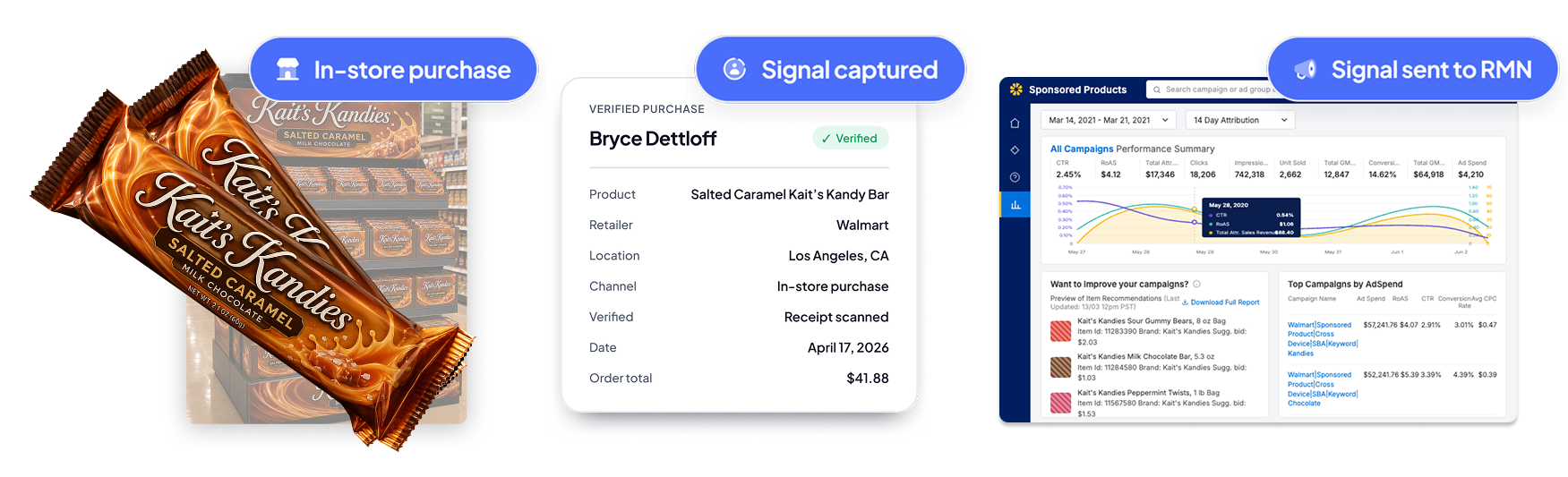
Instead of relying on each retailer's self-reported closed loop, Brij Signal captures the buyer directly at the point of purchase and turns that transaction into a conversion event you control. The mechanism runs shelf to signal in three steps:
Capture. Brij experiences can live in many places: packaging, in-store displays, inserts, or inside a retail media ad itself, like an Instacart in-app placement or a QR on a connected-TV spot. Customers might enter an experience driven by a warranty registration, discount code, or rebate, and can self-identify where they came from or saw the ad in a quick post-purchase survey, or click a link or scan a QR code directly linked to the ad itself. You now have a verified buyer, the specific product, the purchase channel, and the ad that drove the sale.
Signal. That verified purchase is structured as an offline conversion event and sent automatically into the platforms you already run: Meta, Google, and TikTok, and your retail media networks like Walmart Connect. Each one matches it to a profile and folds it into optimization. Where you'd rather move the data yourself, you can; it's yours to export, and the direct integrations simply automate the work.
Optimize and activate. As verified retail events accumulate, the algorithms finally see your full buyer base, targeting and bidding improve, and lookalikes reflect real customers instead of the DTC sliver. And it compounds no matter where the buyer came from: whether the sale started with an Instacart ad or a shelf at Target, every verified purchase you send back makes your RMNs and ad platforms smarter. The same data flows into your CRM so retention can begin.
This unlocks:
- Clear attribution: No more guessing retail media ROI. You hold an independent, deterministic record of retail sales to hold every RMN report against. And because that buyer came in through a link inside the ad or told you where they saw you in a post-purchase survey, you can tie a purchase back to the specific retail media placement that drove it. Budget conversations shift from guessing at retail lift to proving it with your own data.
- Sharper platform performance: Every day you collect data from retail buyers and feed it back, you’re making both your retail media networks (and other ad platforms) smarter + quantifying halo effect.
- Complete audiences: Verified retail buyers sync into your tool stack, so targeted audiences reflect your true customer base, not just DTC. That signal is deterministic and incentivized, which makes it materially higher quality than modeled data. Plus, you can avoid wasted spend with audience suppression.
Upgrade and Own Your Signal Now
If you want to start quantifying your retail media impact this quarter, the path is straightforward. Put a verified-purchase experience on your SKUs or ads to start capturing buyers you currently can't see. Route those events into Meta, Google, TikTok, and your retail media networks so the media driving your retail sales gets credit. Then hold your RMN reports against your own verified data, and take the halo numbers to finance to justify the next round of spend.
Retail media isn't going to stop growing, and brands need deterministic signal to prove what that spend actually did, with data they own. If you want to see how that works for an omnichannel brand like yours, book a demo with Brij.
Sources
- eMarketer: Retail Media Ad Spending Forecast H1 2026
- eMarketer: What advertisers and retailers need to know about retail media heading into 2026
- eMarketer / Bain & Company: Growing retail media networks prioritize measurement and unraveling complexity
- eMarketer: FAQ on in-store retail media — closing the gap between demand and execution
- Koddi / Forrester Consulting: commerce media measurement priority survey (reported via eMarketer