Table of Contents

How Brij Improves Both Sides of the LTV:CAC Equation – Simultaneously

- In 2024+, ad platforms shifted from manual audience targeting to algorithmic optimization.
- The only lever advertisers still control is the quality and completeness of the conversion data they send back.
- Brij is the only growth infrastructure that improves both LTV and CAC simultaneously, with verified retail buyer identity flowing forward into your CRM and backward into your ad platforms as offline conversion events.
- 70-90% of omnichannel brand revenue flows through retail and marketplace channels, yet this data is invisible to Meta, Google, and TikTok by default, meaning the algorithms spending your budget are optimizing against a fraction of your actual buyers.
- Brands using Brij's offline conversion data with Meta see a +28% lift in ROAS and +36% uplift in tracked conversions, with an 8.8/10 Event Match Quality score.
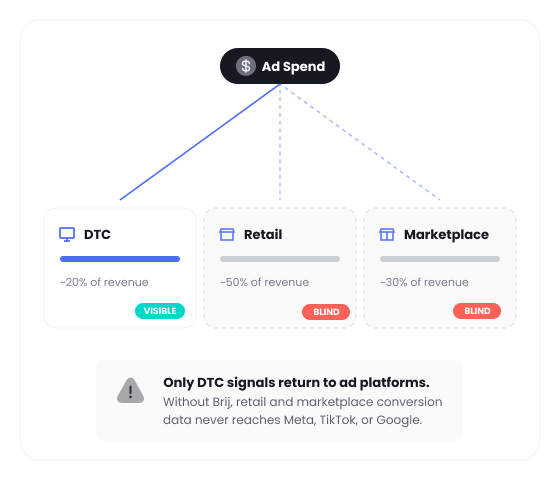
Most omnichannel brands are running Meta Advantage+ or Google Performance Max optimized against a fraction of their actual buyer base. Your ad platforms see DTC purchases. They don't see the customer who bought at Target after seeing your Instagram ad. They don't see the Walmart sale your Meta campaign drove. An estimated 70–90% of purchases at omnichannel brands flow through retail and marketplace channels, and every one of those purchases generates zero signal back to the algorithms spending your budget.
That's the problem Brij was built to solve, on both sides of the P&L.
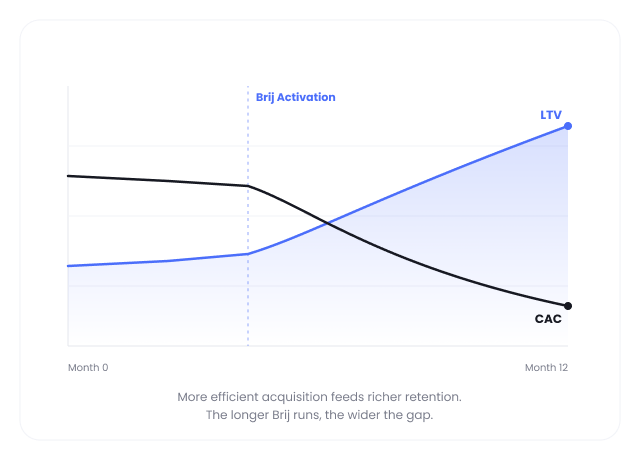
Brij is the growth infrastructure that improves both your LTV and your CAC at the same time. Every time a buyer registers through a Brij experience, two things happen: the data flows forward into your CRM, and it flows backward into your ad platforms as a verified conversion event. One mechanism, two directions. The longer it runs, the wider the performance gap grows between you and every competitor sending incomplete data.
Your LTV:CAC Ratio Is Structurally Distorted
Most performance marketers know their LTV:CAC ratio is the ceiling on how competitively they can grow. What fewer realize is that for omnichannel brands, the ratio is being calculated from a broken data foundation – on both sides.
CAC is inflated. Your customer acquisition cost is calculated against DTC-only conversions, even though the majority of customers you're actually acquiring buy through retail or marketplace channels. Meta optimizes against an incomplete buyer set, audience expansion stalls, and the CPMs you could unlock with a complete picture stay out of reach. You're paying to re-acquire customers who already exist in your buyer base. You just can't see them.
LTV is leaking. Every retail buyer you don't identify is a customer you paid to acquire, and will pay to acquire again next quarter. No reorder email. No subscription path. No DTC conversion. The retention lifecycle that compounds lifetime value never starts because the customer never entered your owned systems.
Brij addresses both simultaneously. Verified retail buyer identity flows forward into Klaviyo, Attentive, Postscript, or your CRM of choice, activating the retention lifecycle. The same identity flows backward into Meta, Google, TikTok, and Walmart Connect as offline conversion events, making your acquisition machine more efficient. One scan. Both directions. The two variables your P&L cares most about move in the right direction at the same time.
Why Now: The Ad Platform Rules Changed
Understanding why offline signal matters so much now requires a quick look at how ad platforms evolved over the past five years.
For most of the 2010s, targeting was the lever. Marketers built competitive advantage through layered interest categories, demographics, and behavioral segments. The sophistication of your audience architecture produced real performance differences. Manual audience design was a skill that mattered.
iOS 14.5 broke that model in 2021. App Tracking Transparency forced opt-in, third-party cookies eroded, and match rates collapsed. The pixel era ended.
What replaced it from 2024 onward is the signal era. Meta's Advantage+, Google's Performance Max, and TikTok's Smart+ campaigns now handle audience selection algorithmically. The model learns from the conversion events you feed it. Manual targeting setup is less important than it used to be. The new lever is the quality and completeness of the conversion data you send back.
The brand that wins the auction today isn't the one with the most sophisticated targeting architecture. It's the one sending the platform the most complete picture of who actually bought.
For omnichannel brands, that's the problem. An estimated 70–90% of their purchases happen outside DTC – at retail or through marketplaces – and none of those purchases return any signal to Meta, Google, or TikTok by default. The algorithms are optimizing against a DTC-only view of a business that runs mostly in retail. Brij closes that gap.
How the System Works
A consumer buys your product at retail or on Amazon. They encounter a Brij experience (a warranty registration, a rebate, a sweepstakes, or exclusive content) and submit their email, phone number, and purchase details in exchange for real value. That's the moment an anonymous retail buyer becomes a known customer.
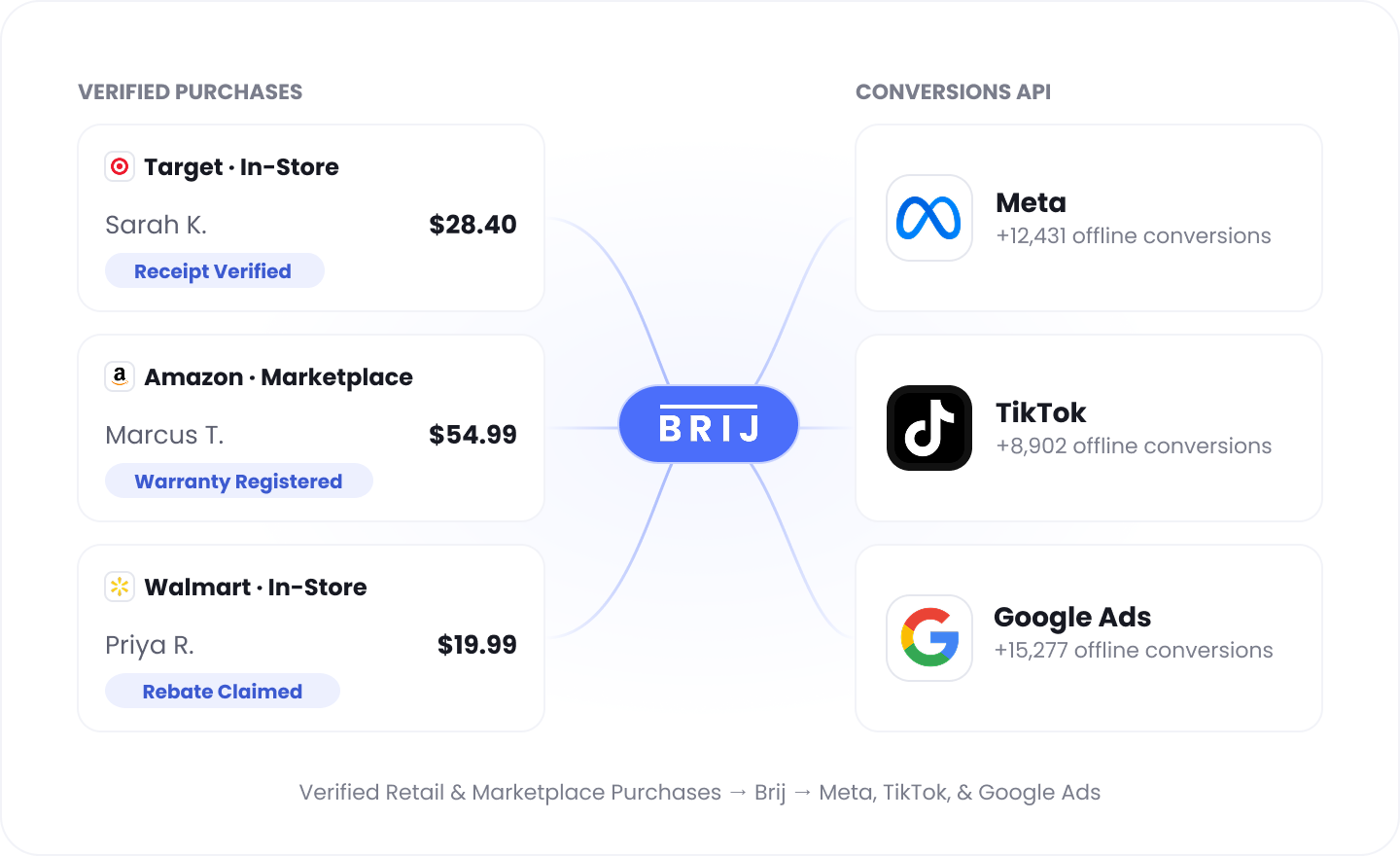
What happens next runs in two directions at once. The verified identity flows forward into your CRM, starting the retention lifecycle: email, SMS, reorder, subscription. And it flows backward into your ad platforms as verified offline conversion events, improving suppressions, strengthening lookalikes, and feeding better signal to the algorithm.
Every scan compounds. Each new verified buyer makes the algorithm smarter, which makes the next dollar of spend more efficient, which reaches more buyers, who register with Brij. The loop tightens over time.
How a Brij Event Becomes a Platform Conversion Event
When a buyer submits a Brij experience form, here's what happens immediately:
- Capture. Brij collects email, phone number, country/region, and purchase details, enough to satisfy ad platform matching requirements without creating friction that hurts completion rates.
- Hash. Brij servers apply SHA-256 hashing to all PII before the data leaves Brij's infrastructure. Raw personally identifiable information never travels anywhere.
- Transform. Brij structures the hashed data as an offline conversion event formatted for the target ad platform's Conversions API.
- Match. The platform's identity graph compares the hashed digest against its own hashed user records. A match ties the purchase back to the person who saw your ad.
- Optimize. The algorithm incorporates the verified conversion, improving bidding, targeting, and audience modeling going forward.
No PII is shared at any point. The platform finds the user through matching hashes on both sides. And your reported ROAS starts reflecting what your ads actually drove, across retail, marketplace, and DTC, instead of just the DTC fraction.
One Identity Layer. Every Ad Platform.
Brij has direct integrations with the four major platforms where omnichannel media budgets run. Each connects to the specific optimization mechanism that platform uses.
Meta: via Conversions API (CAPI), feeding Advantage+ Shopping Campaigns and improving your Offline Data Quality (ODQ) score, and giving the algorithm a complete view of who actually bought across every channel.
Google Ads: via Enhanced Conversions and Offline Conversion Import, feeding Performance Max and Smart Bidding with verified retail purchase events. Retail purchases that previously had no visibility in Google's attribution now flow back as first-party signals in real time.
TikTok: via the Events API, feeding Smart+ Campaigns and expanding audience seed lists with verified buyers from retail and marketplace channels.The same signal completeness that lifts Meta performance applies here: better input data, better algorithmic output.
Walmart Connect: via offline events, feeding Sponsored Search and Display with retail purchase data. As retail media networks grow as an advertising channel, the same mechanism that powers Meta and Google performance extends to Walmart's ad platform — closing the loop between Walmart shelf sales and Walmart media spend.
One identity layer. One mechanism. One set of brand-owned data, flowing to every algorithmic surface where you're spending. Explore all Brij ad platform integrations.
Real-World Proof: Skullcandy × Brij
Skullcandy sells through retail, Amazon, and DTC. They run paid media on Meta, Google, and TikTok. And like most omnichannel brands, the majority of their purchases were happening in channels that returned zero signal to their ad platforms, until they wired Brij in.
The flow: a shopper sees a Skullcandy ad on Instagram. They buy in-store at Walmart or on Amazon. They scan the Brij QR code to register their product – warranty, rebate, or content unlock. That registration becomes a verified offline conversion event that flows into Meta CAPI. The algorithm now knows the ad drove a purchase it couldn't see before.
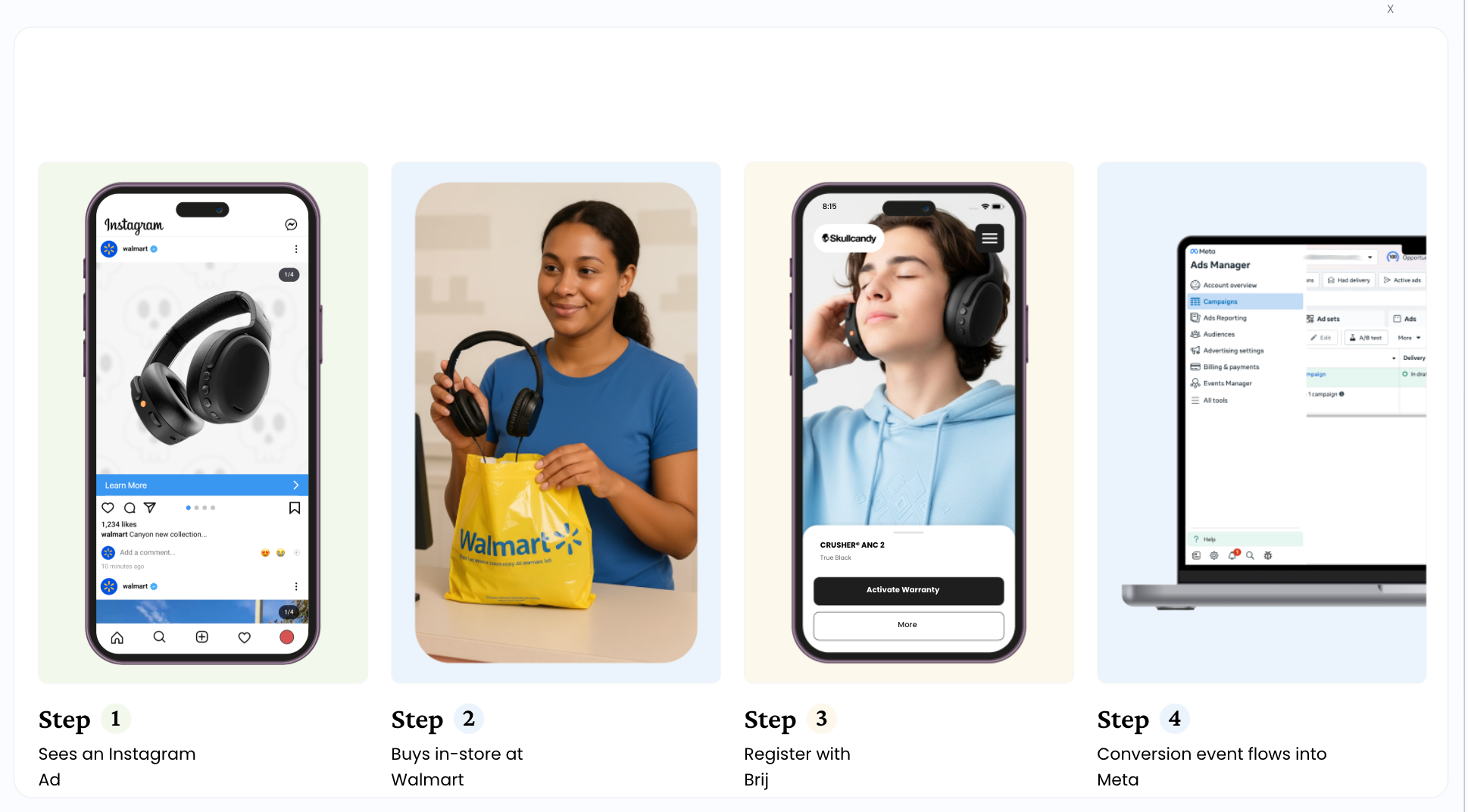
After wiring Brij data into 19 ad sets across their Meta account, Skullcandy saw a +28% lift in ROAS from forwarded offline purchase events, a +36% uplift in tracked conversions vs. ecomm-only, and an Event Match Quality score of 8.8/10 — top of the band for offline data quality.
Google Ads and TikTok followed.
The business logic was clear enough that Skullcandy's VP of Ecommerce, Evin Catlett, made the case to shift media allocation: "Take co-op dollars from our offline retail marketing programs and invest that in Meta — a more effective use of that spend than even spending in retail marketing programs like on Walmart.com."
That's the argument in one sentence. Offline purchase data that used to sit invisible inside a retailer's ecosystem now fuels the ad platform algorithm, and the ROAS improvement justifies shifting media spend accordingly.
How Brij Helps
Brij is not a measurement platform, which only tell you what already happened. Brij improves what happens next. The signal Brij sends to your ad platforms doesn't just close the attribution loop; it actively changes what the algorithm does with your next dollar of spend.
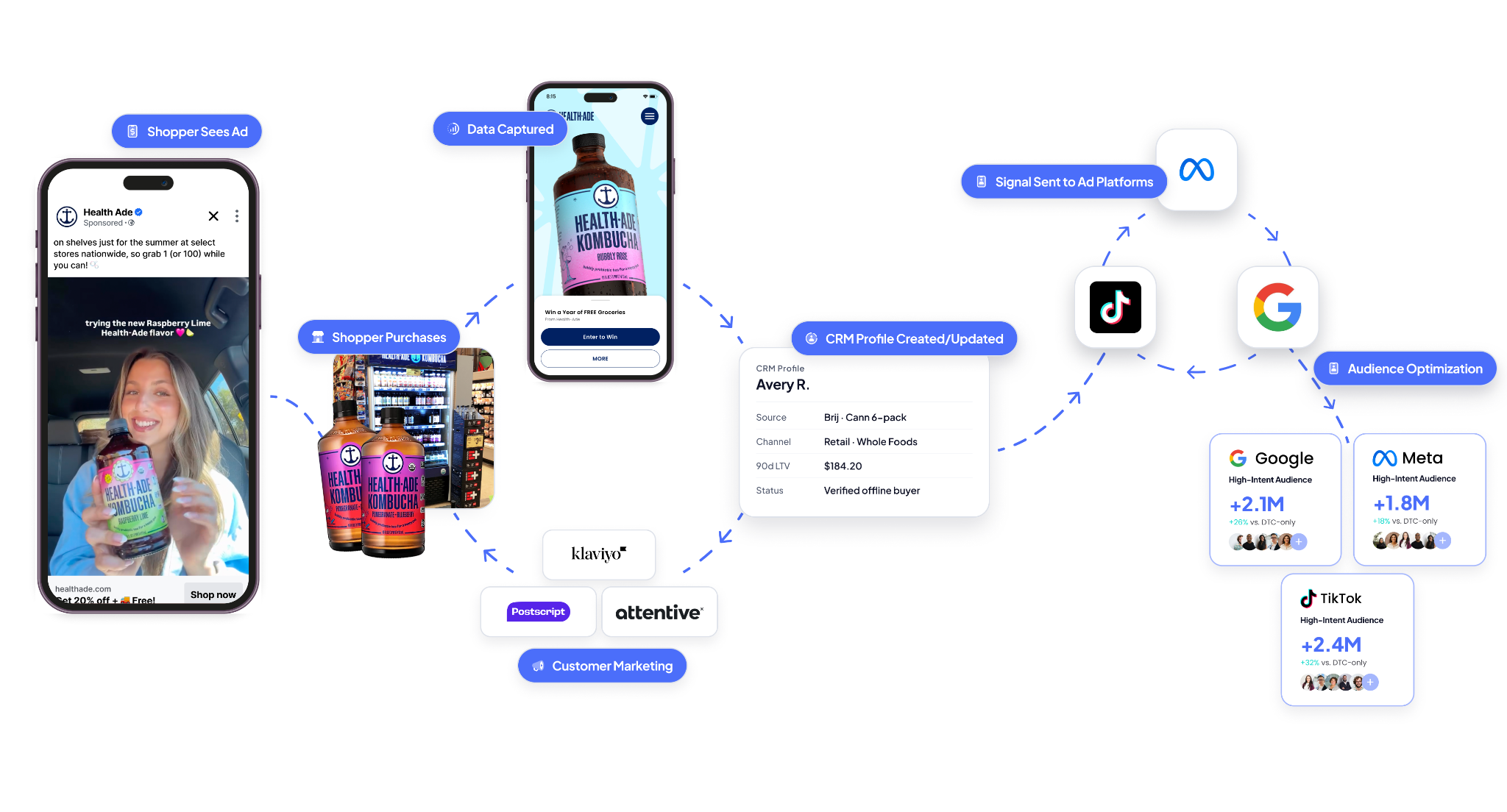
The three activation benefits on the acquisition side:
Better suppressions. When a retail buyer registers with Brij, your ad platforms know they purchased. That person can be excluded from acquisition campaigns immediately, eliminating waste on audiences you already converted.
Stronger lookalikes. Lookalike audiences built from DTC-only data represent a narrow subset of who actually buys your product. Brij feeds verified retail and marketplace buyers into the match pool, producing lookalikes that reflect your complete customer base.
Higher ROAS. As verified offline conversion events accumulate, bidding, targeting, and delivery improve, not because you changed your creative, but because the algorithm finally has a complete picture of who's buying.
And on the retention side, every identified retail buyer enters your owned stack: email, SMS, reorder, subscription, DTC pathways. Two sides of the P&L. One platform. One compounding system.
Book a demo with Brij to see how the ad platform integrations work for an omnichannel brand like yours.