
Table of Contents

Marketing Mix Modeling Is Only as Good as the Signal You Feed It

- A marketing mix model (MMM) uses aggregate statistical modeling to estimate which channels drive sales, so its accuracy depends entirely on the completeness of the purchase data it is fed.
- For most omnichannel brands, 80%+ of revenue flows through retail and marketplace purchases that never reach the model, forcing it to infer performance it cannot see, which is a signal problem, not a modeling problem.
- Brij is not an MMM or MTA; it is the deterministic signal layer beneath them, capturing verified retail and marketplace purchases at the SKU, retailer, geographic, and customer level.
- Brij ships that deterministic data into Meta, Google, and TikTok, into Klaviyo, Attentive, and Postscript, and into your MMM or MTA, sharpening targeting, retention, and modeling from the same input.
Nearly half of US marketers (46.9%) plan to invest more in marketing mix modeling in 2026 [1]. Brands are pouring budget into MMM, MTA, and incrementality tools to finally answer the question every CFO asks: which marketing is actually working?
Here's the catch. A marketing mix model is only as good as the data you feed it.
Most omnichannel brands are feeding their systems a partial, modeled picture of demand, then asking it to model on top of that. If you're paying for an MMM or MTA and sending it modeled or incomplete offline data, you're almost certainly leaving value on the table.
This isn't an argument to rip out your model. It's an argument to feed it something better.
What Does a Marketing Mix Model Actually Do?
Before we get to the gap, it's worth being precise about what these tools are.
A marketing mix model (MMM) uses aggregate, statistical modeling to estimate how each channel (paid social, search, retail media, TV, email) contributes to sales over time. It's privacy-safe and top-down. It doesn't track individuals; it correlates spend against outcomes to tell you which channels are working and where the next dollar should go.
Multi-touch attribution (MTA) works bottom-up. It stitches together the individual touchpoints on the path to a conversion and credits the channels involved.
Both are probabilistic. They infer and estimate rather than observe every purchase directly. That is not a flaw; it's how they're designed to work, and they do a lot well. But it means their outputs are only as reliable as their inputs.
Feed them clean, complete purchase data and they sharpen. Feed them a fraction of your real demand, and they fill in the rest with guesses.
The Retail Black Box
That's exactly where most omnichannel brands run into trouble. They're feeding their MMM and their ad platforms an e-commerce-only picture of demand. Retail, wholesale, and in-store purchases, the majority of revenue for most omnichannel brands, show up as a void. We call that void the retail black box.
For many brands, that void is 80% or more of the business. When 80%+ of your sales never reach the model as a real, confirmed purchase, there are a lot of inferences being made behind the scenes.
Why DTC-Only Signal Quietly Breaks Your Model
A marketing mix model is only as good as its inputs. So is an ad algorithm. When the only purchase events you can feed back are DTC transactions, every downstream calculation inherits that blind spot.
Three things break at once:
- Attribution gets distorted. As click-level signal erodes from privacy changes and platform shifts, marketers report that a meaningful share of conversions are no longer reliably trackable, directionally in the 30-40% range per eMarketer, which means the model is inferring retail performance it cannot actually see.
- Targeting gets starved. Algorithms like Meta's Advantage+, Google's Performance Max, and Andromeda optimize against the conversion events you send back. Feed them only DTC buyers, and they model your audience off a fraction of your real customer base.
- The LTV:CAC ratio gets misread. When retail buyers are invisible, CAC looks overstated and LTV looks like it's leaking, because a huge slice of the customers your ads actually drove never appear in your data.
None of this is a modeling failure. It's a signal failure. The model is doing exactly what it was built to do with the data it was handed. The industry knows accuracy is the real issue: the top barrier to getting incrementality right is concern about the accuracy or reliability of results (44%), per eMarketer citing Skai and the Path to Purchase Institute.
How Brij Is Different: The Signal Layer Beneath Your Models
Brij is not an MMM, an MTA, or an incrementality platform. It doesn't compete with them, and it isn't another dashboard. Those tools measure what already happened. Brij determines what they get to measure in the first place.
Think of Brij like a data channel. It captures verified offline and marketplace purchases through branded experiences like rebates, warranty registration, and sweepstakes, then turns those purchases into deterministic, identified buyer events. Probabilistic tools are great. Probabilistic tools that have been fed real, deterministic offline purchase data are exceptional.
Put simply: MMM tells you which channels are working. Brij makes the underlying signal better, so the model can see retail and marketplace performance instead of inferring it. Better inputs, sharper outputs.
.png)
How Brij Works: Shelf to Signal
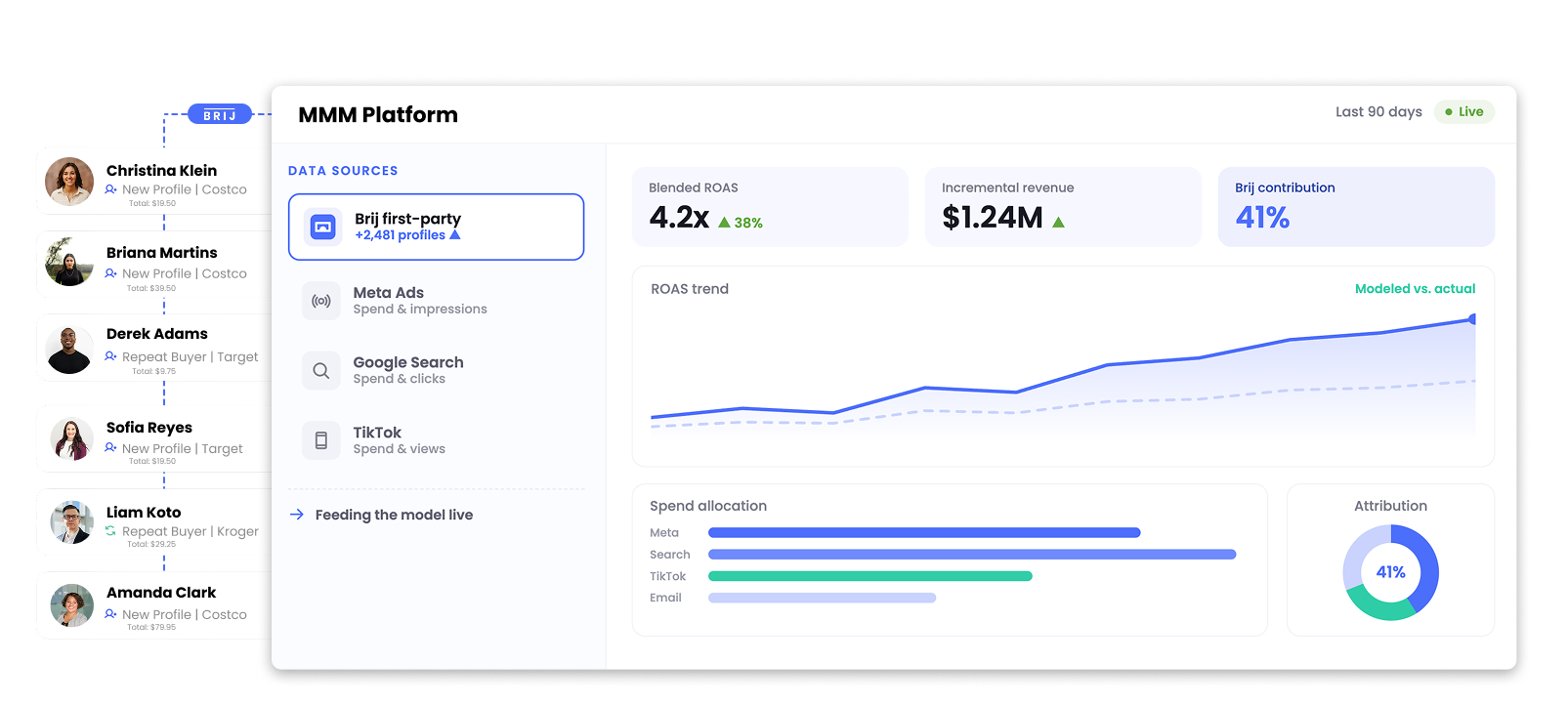
Brij captures verified retail and marketplace purchase events at the SKU, retailer, geographic, and customer level. Then, identifies them as real named customer profiles, moving them from unknown to known.
Brij ships that deterministic data into your most important tools as signal:
- Into Meta, Google, and TikTok, to improve on-platform targeting and attribution
- Into Klaviyo, Attentive, and Postscript, to power LTV-driving retention flows
- Into your MMM and/or MTA solutions, to sharpen the models you've already invested in
The payoff is that targeting, retention, and attribution improve together, from the same input. Your ad platforms optimize against real buyers, your CRM and retention flows fire on real purchases, and your model finally sees retail performance instead of inferring it.
The Feedback Loop that Makes Your Model Smarter
Once Brij is feeding deterministic purchases into your stack, it's effectively proving (or disproving) whether the purchases your MMM or MTA modeled actually happened. That feedback loop is what makes the model meaningfully smarter over time. You stop optimizing against a best guess and start optimizing against what really occurred.
If you're paying for an MMM or MTA and feeding it modeled or partial offline data, you could be getting far more value out of the investment you've already made. Brij offers the highest-quality deterministic input your retail and marketplace sales data can produce.
The Bottom Line
Your MMM isn't broken. It's starving.
It can only model the demand it can see, and for most omnichannel brands, the majority of demand never reaches it. The brands getting the most from their measurement investment aren't buying smarter models; they're feeding the ones they have a complete, deterministic signal.
If you want to see how your modeling changes with verified retail and marketplace data in the stack, book a demo with Brij.
Sources
- eMarketer: MMM, incrementality, and other measurement trends that will define 2026
- eMarketer: Incrementality takes center stage, but there's still work to be done