Table of Contents

Navigating the New Era of Food Testing Legislation

- State laws focused on heavy metals transparency (like California's AB 899 and SB 646) and ingredient disclosure (like Louisiana's SB 14) both require a QR code on-pack linking to a compliant, manufacturer-controlled web experience.
- With multiple states actively enforcing or passing legislation, compliance is no longer solely a manufacturer responsibility; retailers are facing direct liability for selling non-compliant products.
- Relying on disparate, vendor-by-vendor solutions creates a fragmented consumer experience and significant compliance risk as regulations expand.
- Brij allows brands to manage both heavy metal and ingredient disclosures through one dynamic QR code, future-proofing compliance.
- Leaders like Once Upon a Farm demonstrate how proactive compliance can be turned into a competitive advantage by delivering parent-friendly, branded experiences.
The regulatory landscape for consumer food products is undergoing a structural shift. What began as isolated state-level initiatives has rapidly accelerated into a nationwide movement demanding unprecedented transparency from food manufacturers.
Two distinct legislative movements are currently driving this change. The first focuses on heavy metals transparency in baby food and prenatal vitamins. The second targets ingredient-level disclosure for additives and dyes. While these tracks address different consumer concerns, they are converging on the exact same requirement: a QR code on-pack, linking to a compliant, branded, manufacturer-controlled web experience.
For brands and retailers, this convergence creates a critical inflection point. The question is no longer whether to build compliance infrastructure, but whether to build it once or build it seven times as more states adopt equivalent mandates.
Track 1: The Escalating Wave of Heavy Metals Transparency
The push for heavy metals transparency began with California's AB 899, a first-in-the-nation law requiring baby food manufacturers to test monthly for arsenic, cadmium, lead, and mercury, and to make those results publicly available via QR codes on packaging.
This legislation has quickly become a blueprint for other states. Maryland followed with near-identical legislation (Rudy's Law), which includes a sales ban for non-compliant products.
Virginia's Baby Food Protection Act took effect in January 2026, and Illinois unanimously passed its own version effective in 2027. Federal legislation, the Baby Food Safety Act (HR 2472), is also pending in Congress, which would give the FDA authority to set and enforce heavy metals limits nationally.
Enforcement is real and escalating. In March 2026, California's Attorney General issued an industry-wide enforcement advisory explicitly warning that retailers selling non-compliant baby food may face action under California's Unfair Competition Law. Compliance is no longer solely a manufacturer responsibility; retailer liability is immediate.
Furthermore, the scope is expanding. California's SB 646, taking effect in January 2027, extends these exact same disclosure requirements to prenatal multivitamins. The scope now extends to what a mother takes before her child is even born. This demonstrates that the heavy metals regulatory framework is broadening upward and outward, making the case for a single scalable infrastructure even more urgent.
Track 2: The Rise of Ingredient Disclosure Mandates
Running parallel to the heavy metals legislation is a second, independent QR mandate focused on ingredient disclosure.
Louisiana SB 14, signed into law in June 2025, requires food products containing any of 44 listed ingredients, including artificial dyes like Red 40 and Yellow 5, preservatives like BHA and BHT, and artificial sweeteners, to carry an on-pack QR code. This code must link to a compliant, manufacturer-controlled web page featuring specific FDA notice language.
These labeling provisions take effect January 1, 2028. Texas passed a parallel law the same week, and several other states, including West Virginia, Oklahoma, and Arizona, have related legislation in motion. Legal experts are flagging this as a growing state-by-state patchwork problem.
The Problem with a Patchwork Approach
As these mandates stack up, brands and retailers attempting to solve compliance product-by-product or vendor-by-vendor are finding that the approach breaks down at scale.
A review of current compliance efforts often reveals a fragmented landscape: some products link to static PDFs hosted on a retailer's CDN, others point to generic third-party platforms, and some have no results available at all.
This creates several significant risks:
- No Central Visibility: Without a single place to see which SKUs are compliant, which are pending, and which are at risk, oversight becomes nearly impossible.
- Inconsistent Consumer Experience: A parent scanning a QR code might land on a static PDF, an unbranded third-party site, or a broken link. This inconsistency erodes consumer trust and fails to meet the expectations of modern shoppers.
- Compliance Risk: Many existing solutions lack lot-level lookup capabilities, which are required by laws like AB 899. Products resolving to non-compliant destinations may be legally unsellable in states with active enforcement.
- Inflexibility: Every new state law or FDA action level exposes gaps in a patchwork system, often requiring the infrastructure to be rebuilt from scratch.
Two Tracks. One Infrastructure Answer: Brij
Both regulatory tracks converge on the same physical artifact: a QR code on-pack linking to a compliant web experience. The strategic move is to build a single platform that handles both tracks with a change in the content module, not the underlying infrastructure.
A centralized platform allows for:
- Dynamic Lot-Level Data: Monthly updates from multiple labs with seamless UPC/lot lookup and consumer education for heavy metals (covering both AB 899 and SB 646).
- Static Ingredient Disclaimers: Dedicated pages with SB 14 required notice language and FDA links for ingredient disclosure laws.
- Automated Expiration and Access Control: Set expiration dates for test results so outdated information automatically hides from the consumer-facing portal.
- Future-Proofing: As the FDA finalizes new action levels or more states pass equivalent mandates, the Brij platform allows you to update without requiring re-engineering per state.
Turning Compliance Into a Competitive Advantage: Once Upon a Farm
Leading brands are already demonstrating that compliance doesn't have to be a burden; it can be a powerful tool for building trust.
Once Upon a Farm, a pioneer in the baby food industry, recognized that static PDFs would not satisfy their commitment to transparency. They partnered with Brij to power a fully customized transparency experience originally built for AB 899.
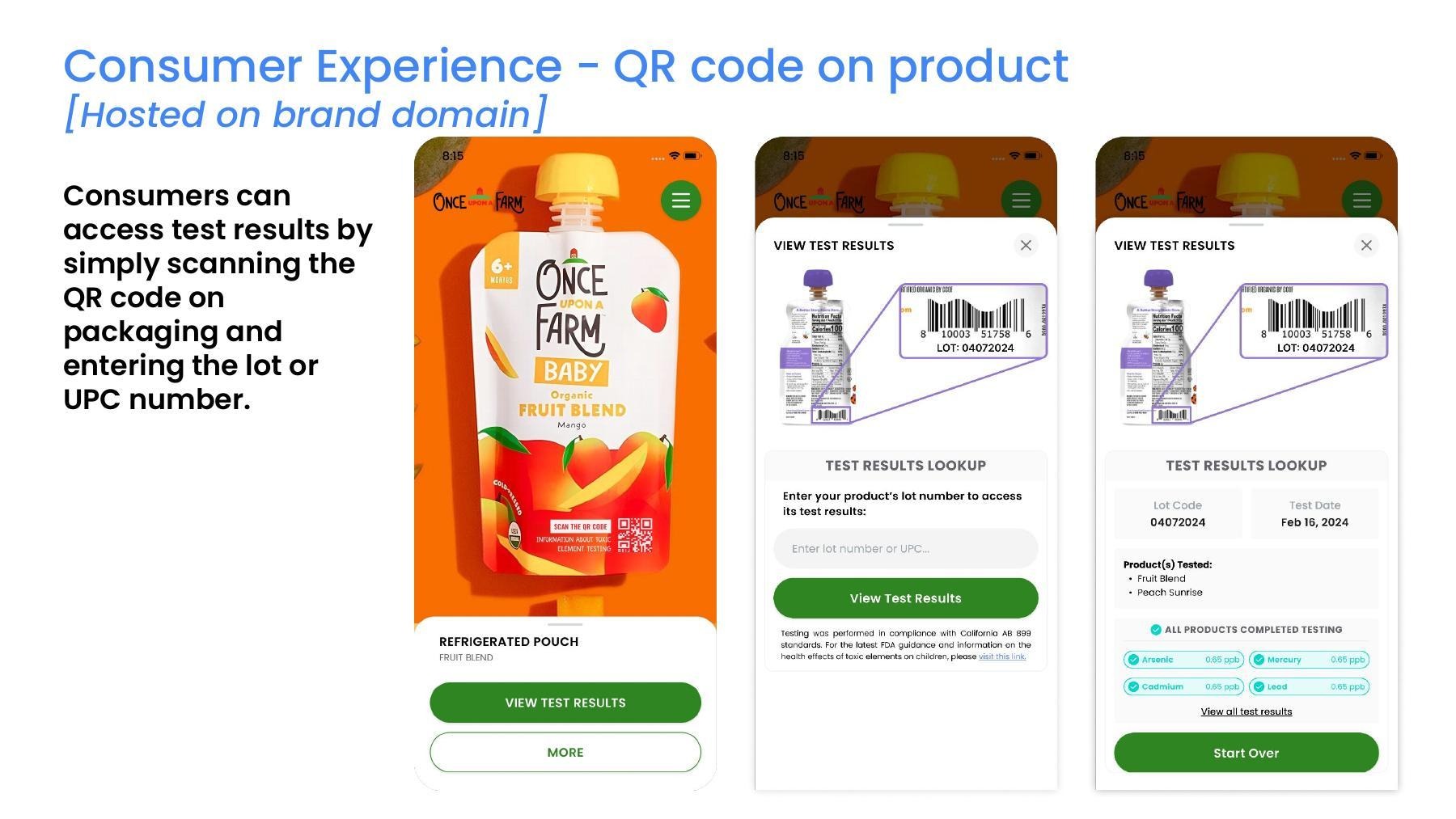
Using Brij's platform, Once Upon a Farm created a mobile-first experience that combines education with action. When a parent scans the QR code on a Once Upon a Farm product, they don't just see raw numbers. They find branded educational modules explaining product quality, clear guidance on finding UPCs and lot numbers, and an interactive lookup tool to instantly access test results.
The dynamic views display heavy metal levels alongside test dates and expiration timelines, providing clear, contextualized information. The same infrastructure and workflows Once Upon a Farm uses for AB 899 directly apply to SB 646 for prenatal supplements.
Behind the scenes, Once Upon a Farm manages all testing data directly within Brij, uploading results, validating lot data, and standardizing lab outputs. This seamless connection between compliance operations and the consumer experience turns a regulatory requirement into a competitive advantage.


The Bottom Line
The regulatory wave is not slowing down. As states continue to pass transparency mandates, the brands and retailers who build their compliance infrastructure now – as a single, scalable platform – will be the ones who can move quickly when the next mandate arrives.
Brij is purpose-built for exactly this challenge. As the compliance and consumer experience platform powering QR-code-based transparency for over 180 brands, Brij provides the infrastructure needed to meet today's requirements and adapt to tomorrow's regulations, all while delivering the branded, trust-building experiences that consumers demand.