Table of Contents

Why Deterministic First-Party Data Matters More Than Ever

- Most omnichannel brands optimize marketing using only about 20% of customer purchases, because retail and marketplace buyers are invisible.
- Brij captures those previously invisible purchases as verified, first-party customer signal.
- Deterministic solutions verify customer identity, while probabilistic solutions estimate it using behavioral or statistical signals. Modern marketing platforms work best when they're supplied deterministic customer events instead of inferred ones.
- Brij captures verified retail and marketplace purchases, then activates that deterministic first-party signal across Meta, Google, TikTok, Klaviyo, Attentive, Postscript, and other marketing platforms.
- Unlike point solutions that only measure performance or capture data, Brij improves both sides of the LTV:CAC equation by strengthening acquisition through better ad signals and increasing lifetime value through richer customer relationships.
Most omnichannel brands optimize marketing using only about 20% of their customer purchases.
The other 80% happen in retail stores and marketplaces, where those customers never make it into Meta, Google, TikTok, Klaviyo, or your CRM.
Brands have spent years trying to close that gap with attribution platforms, identity graphs, marketing mix models (MMM), and other marketing technologies. Those solutions are valuable, but they're built to estimate what happened after the fact because they were never given the underlying customer signal in the first place.
That's the difference between probabilistic and deterministic solutions.
One estimates. The other verifies.
That distinction is quietly determining how much you pay to acquire customers, how accurately you measure marketing performance, and whether you can build long-term customer relationships beyond the initial purchase.
Deterministic vs. Probabilistic Solutions
Deterministic solutions are built on verified customer data
A real customer bought a real product, at a real retailer, at a specific time. That purchase is tied to a verified identifier like an email address or phone number, creating a match with near-100% confidence. There's no inference involved. A hashed phone number either matches Meta's system, or it doesn't.
Because the underlying signal is verified, downstream systems can act on it with confidence.
Probabilistic solutions work differently.
Rather than verifying an individual customer, they infer what most likely happened using signals like device IDs, IP addresses, browsing behavior, location, or statistical modeling.
That's incredibly useful when verified data doesn't exist, but it also means there's always uncertainty. The output is an educated estimate, not a confirmed customer or purchase.
The practical difference shows up the moment you need precision. If you're trying to personalize a message to one specific customer, or make your ad audiences stronger based on who already bought your product, a probabilistic match introduces error you can't see or audit.
What Does this Look like in the Tools You Actually Use?
The question isn't whether you're using probabilistic tools. You almost certainly are. The real question is whether you're feeding them deterministic customer signal beyond your ecommerce website.
Nearly every modern marketing tool relies on probabilistic modeling to some degree. Not because the technology is flawed, but because it's often working with incomplete information.
Marketing mix models (MMM) estimate how channels contributed to revenue. Multi-touch attribution (MTA) reconstructs likely customer journeys. Identity graphs connect devices and behaviors to probable individuals. Even advertising platforms use machine learning to predict which people are most likely to convert.
These tools become dramatically more effective when they're supplied deterministic customer events instead of inferred ones.
That's where Brij fits. Rather than replacing probabilistic tools, Brij provides the verified first-party purchase signal they were missing.
First-Party Data Vs. Third-Party Data
Deterministic and probabilistic describe how confident you are in a data match. First-party and third-party describe who owns the relationship behind the data.
First-party data is anything a brand collects directly from its own customers: purchases, site visits, email replies, survey answers. Third-party data is collected by an entity with no direct relationship to the buyer at all, then aggregated and sold or licensed to whoever wants it.
A brand's own first-party CRM data can still be matched probabilistically across devices. A receipt-scanning panel like Fetch or Ibotta captures purchase data deterministically at the individual level, but that data lives inside the panel's own walled garden. You're accessing someone else's customer data, not building your own.
The highest-value customer data is both deterministic and first-party:
- verified
- owned by your brand
- permissioned by the customer
- portable across your marketing stack
That's the combination Brij creates by making previously invisible retail and marketplace purchases visible, then turning them into deterministic, first-party customer signal.
How Brij Creates Deterministic First-Party Signal
Most omnichannel brands lose visibility into roughly 80% of customer purchases because they happen in retail stores, on Amazon, or through wholesale partners.
Brij makes those previously invisible purchases visible.
A shopper engages a branded Brij experience (a rebate, a warranty registration, a sweepstakes, gated content, loyalty activation, etc.). They voluntarily submit their email or phone number, sometimes a receipt.
The result is deterministic, first-party customer signal owned by the brand, not modeled, rented, or inferred.
From there, Brij activates that verified customer signal across the marketing stack.
The verified profile is hashed and sent to Meta, Google, and TikTok as an offline conversion event, helping improve targeting, bidding, audience creation, attribution, and campaign optimization.
The same verified buyer data syncs directly into Klaviyo, Attentive, and Postscript, powering segmented reorder reminders, replenishment flows, cross-sell campaigns, subscription invitations, onboarding journeys, post-purchase education, and more.
Brij Feeds Deterministic Signal into Meta, Google, and TikTok
Brij is the signal layer. It sends deterministic, verified offline purchase events that make modern ad platforms work for omnichannel brands.
Every major ad platform runs on algorithms (Meta's Andromeda, Google's Performance Max, TikTok's optimization models) that decide who sees your ads and how much you pay for the result. Those algorithms are only as good as the conversion data they're given, and for an omnichannel brand, that data has historically covered just the DTC slice of the business, roughly 20% of total sales.
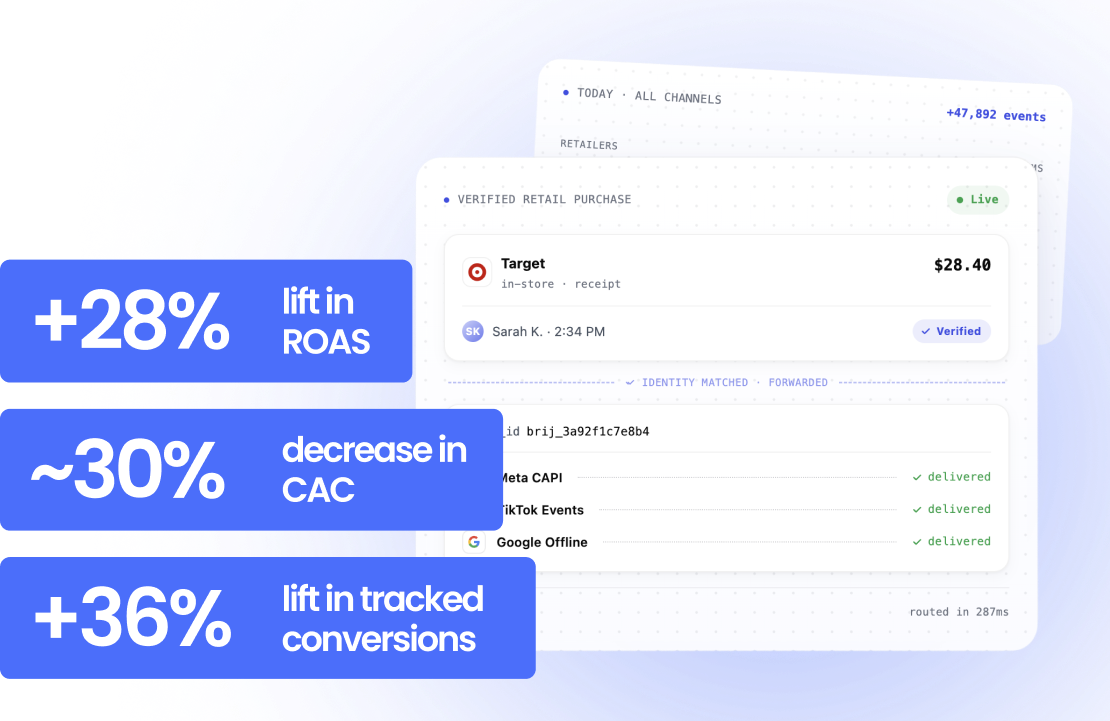
Brij sends the verified retail and marketplace purchase event directly into Meta, Google, and TikTok Ads through each platform's Conversions API, as a real, hashed, deterministic offline conversion. Brands using this integration have reported ROAS lifts as high as 28% and a 36% increase in tracked conversions compared to ecommerce-only measurement, alongside an average event match quality of 8.8 out of 10.
By giving the algorithm real signal to optimize against, attribution and ROAS improve immediately. The more data you feed the platform, the stronger the algorithm gets, and targeting and lookalikes continue to improve.
Brij Feeds Deterministic Signal into Your CRM and Lifecycle Stack
The same verified event that improves ad performance also solves a second, separate problem: your CRM can't build relationships with customers it doesn't know exist..
Brij maps every verified buyer into the brand's CRM and lifecycle tools, including Klaviyo, Attentive, and Postscript, either updating an existing profile or creating a new one enriched with retailer, SKU, and survey-level context.
For brands selling primarily through retail or marketplaces, Brij is frequently the largest source of new, identified contacts they have.
- Brij has become a primary driver of Quip's email marketing success and Klaviyo list growth, with emails collected via Brij accouting for 50% of total new subscribers.
- Similarly, Highpour used Brij for a sweepstake campaign and more than doubled its total email list.
The Compounding Advantage
Unlike point solutions that capture data or measure what already happened, Brij creates the signal that improves both sides of the LTV-to-CAC equation simultaneously.
Better acquisition signal feeds better retention data, and better retention data compounds the value of every dollar already spent acquiring that customer.
You can't lower CAC for a customer you can't verify, and you can't grow LTV on a customer you've never met. Book a demo to see how Brij makes retail and marketplace purchases visible, then turns them into deterministic, first-party customer signal across your entire marketing stack.
Sources
- GrowthLoop: Deterministic vs. Probabilistic Matching
- Digiday: What is the difference between deterministic and probabilistic identity data?
- Amperity: First-Party vs. Third-Party Data: What Marketers Need to Know in 2026