Table of Contents

Why First-Party Data Is Critical for Omnichannel Brands

- First-party data consists of consented, proprietary customer information collected through owned channels, providing high accuracy, low privacy risk, and exclusive competitive advantage.
- Rising customer acquisition costs, retail channel data ownership, and third-party cookie deprecation make direct customer relationships and first-party data essential for sustainable growth and marketing effectiveness.
- First-party data enables personalized marketing, improved attribution, increased customer lifetime value, and real-time behavioral insights, with measurable impacts on revenue growth and cost efficiency.
- Brij converts offline retail interactions into digital relationships by capturing and activating first-party data, enabling omnichannel visibility and direct customer engagement.
The modern shopping experience has become overwhelmingly fragmented. Between digital ads, social media, marketplaces, and physical retail shelves, the average retail consumer interacts with nearly six different touchpoints before making a purchase. [1]
Yet, despite this proliferation of channels, many brands find themselves losing touch with the very people buying their products.
When brands sell through retail and marketplaces, they often face a "black box" problem. They know their products are selling, but they do not know who is buying them. This disconnect means that when a retail-first brand loses a customer, that customer simply disappears. No email, no phone number, no way to re-engage.
In an era where customer acquisition costs (CAC) have skyrocketed by 222% over the past eight years, [2] losing the relationship with the end consumer is not only a missed opportunity; it is an expensive one.
The solution lies in owning the customer relationship through first-party data. This post breaks down what first-party data is, why it has become mission-critical for brands, what marketers can actually do with it, and how Brij makes it possible to capture it at scale.
What Is First-Party Data?
First-party data is the most important and relevant data a company can possess. It consists of proprietary information about a brand's own customers, users, and visitors, collected directly through owned channels such as a website, mobile app, email list, loyalty program, product registration, or in-store interactions. [3] Because consumers have explicitly consented to share this information, it is highly reliable, accurate, and privacy-compliant.
To understand its value, it helps to compare it against the other data types:
First-party data:
- Collected directly from your own customers
- Exclusive to your brand
- Low cost
- Low privacy risk (consent-based)
Second-party data:
- Shared with or purchased from a partner brand
- Shared between two parties
- Moderate cost
- Moderate privacy risk
Third-party data:
- Aggregated by a large data broker and sold broadly
- Available to any paying entity
- Variable cost
- High privacy risk
Why Is First-Party Data Critical for Brands Today?
The marketing landscape is undergoing a seismic shift, driven by economic pressures, evolving consumer expectations, advancing AI, and a heightened focus on privacy. First-party data has transitioned from a "nice-to-have" to a critical survival tool for any brand serious about growth.
The Retail Black Box
For brands that rely heavily on wholesale, retail, or marketplace channels, the lack of direct customer relationships is a glaring vulnerability. You may have strong retail velocity, but without knowing who is buying your products, you cannot retarget them, cross-sell to them, or build long-term loyalty. When a customer purchases your product off a Target or Walmart shelf, the retailer owns that transaction data – not you.
This is the retail black box. The brand invests in product development, packaging, and trade marketing to get the product on the shelf, but the moment a sale happens, the customer relationship belongs to the retailer. The brand is left with sell-through data but no consumer identity, no contact information, and no way to continue the conversation.
Rising Customer Acquisition Costs Make Retention Non-Negotiable
The economics of customer acquisition have fundamentally changed. In 2013, merchants lost an average of $9 for every new customer acquired. Today, that figure has climbed to $29 per customer – a 222% increase. [2] As digital advertising channels become increasingly saturated and competition intensifies, relying solely on performance marketing to acquire new customers is no longer a sustainable growth strategy.
Brands that invest in first-party data can break this cycle. By owning direct relationships with their customers, they can re-engage existing buyers through owned channels – email, SMS, and personalized content – at a fraction of the cost of paid acquisition. The data you already have is your most cost-effective marketing asset.
The Deprecation of Third-Party Cookies and Rising Privacy Regulations
The regulatory and technical landscape is making third-party data increasingly unreliable. Privacy regulations such as GDPR in Europe and CCPA in California have imposed strict requirements on how consumer data is collected and used, with $1.26 billion in GDPR fines issued in 2024 alone. [4] Meanwhile, browser-level restrictions from Safari and Firefox already block third-party cookies by default, and Google has signaled a continued move away from cross-site tracking.
The industry has taken note. 62% of brand marketers say first-party data will become even more important over the next two years. [5] As third-party tracking becomes less reliable, marketers who have not built a robust first-party data strategy will find themselves flying blind, unable to target, personalize, or measure their campaigns effectively.
The Rise of AI Shopping and the New "Blind Spot"
A new, massive challenge to brand visibility has emerged: the rapid adoption of AI shopping assistants and LLM-driven product discovery. According to recent data from Adobe, generative AI traffic to retail sites has exploded, surging 4,700% year-over-year as of July 2025. [6] Consumers are increasingly bypassing traditional search engines and brand websites, instead asking AI agents to find, compare, and recommend products for them.
While this creates frictionless experiences for consumers, it creates a new layer of disintermediation for brands. When an AI agent scans the internet to build a shortlist of products, the brand narrative is often written by third parties – publishers, reviewers, and Reddit threads – rather than the brand itself. If a brand does not own its customer relationships, it has no direct line of communication to influence that buyer.
As McKinsey notes, AI agents could mediate up to $5 trillion of global consumer commerce by 2030. [7] If you rely entirely on third-party discovery and do not capture first-party data, your brand risks becoming invisible in the AI-driven shopping ecosystem. Owning first-party data allows you to proactively reach out to your customers via email and SMS, bypassing the AI "gatekeepers" entirely and ensuring your brand stays top-of-mind.
What Marketers Can Do With First-Party Data
Proper use of first-party data supports personalized customer experiences, customer retention, and regulatory compliance. When accuracy, privacy, and consent are maintained, the value unlocked is substantial. Here are the most impactful use cases for marketers.
1. Deliver Hyper-Personalized Experiences
Today's consumers do not just appreciate personalization. They expect it. According to a 2025 global study of 3,300 consumers, 81% of shoppers ignore irrelevant marketing messages, and 96% say they are likely to purchase when brands send personalized communications. Furthermore, 71% of consumers want brands to learn from their shopping habits over time. [8]
Three factors that drive customer loyalty stand out from the same research: 66% of consumers say they are loyal to brands that remember their preferences, 52% value relevant product suggestions, and 47% appreciate when brands remember their past interactions. [8]
First-party data is the engine that makes all of this possible. Research consistently confirms that personalization driven by first-party data can lift revenues by 10 to 15 percent, with companies that master 1:1 personalization generating up to 40% more revenue than their peers. [9]
2. Improve Marketing Attribution and Understand What Is Working
One of the most underappreciated benefits of first-party data is its power to improve marketing attribution. Without reliable first-party data, brands are left guessing which channels, campaigns, and messages are actually driving purchases.
First-party data helps tie online campaigns to real-world outcomes – purchases, registrations, and event attendance – enabling far more accurate measurement of ROI. Brands that invest in first-party data see a 2.9X revenue increase and 1.5X cost savings compared to those relying on third-party data. [10] When you know who your customers are and how they behave, you can invest your marketing budget with confidence.
3. Increase Customer Loyalty and Lifetime Value
Owning the customer relationship means you do not have to rent access to your own audience from Facebook or Google every time you want to re-engage them. With a direct line to your customers through email and SMS – built on first-party data – you can proactively re-engage lapsed buyers, launch targeted loyalty programs, and create personalized post-purchase journeys that turn one-time buyers into repeat customers.
Email marketing, fueled by first-party data, continues to deliver one of the highest returns of any marketing channel, generating an average ROI of $36 for every dollar spent. [11] The brands that build owned audiences today are the ones that will be most insulated from rising ad costs and algorithm changes tomorrow.
4. Enable Real-Time Customer Behavior Analysis
First-party data provides a live, dynamic view of how your customers interact with your brand across every channel. By tracking behaviors such as product registrations, purchase history, content engagement, and survey responses, you can identify trends, spot at-risk customers before they churn, and uncover new opportunities for growth.
This kind of real-time intelligence is simply not possible with aggregated third-party data, which is often outdated, inaccurate, and shared with your competitors.
How Brij Unlocks First-Party Data for Omnichannel Brands
For brands selling through retail and wholesale channels, the biggest challenge is bridging the gap between a physical product purchase and a meaningful digital relationship. This is precisely the problem Brij was built to solve.
Brij is the AI-powered omnichannel marketing platform that turns unknown offline shoppers into known, loyal customers. By embedding Brij-powered QR codes or digital links on product packaging, inserts, social media, or in-store, brands can capture valuable first-party data directly from the consumer at the moment of highest engagement: right after they purchased the product.
Turning Every Product Into a Data Capture Touchpoint
Brij transforms a simple QR code scan or link click into an engaging, branded digital experience. Instead of a generic landing page, customers are greeted with interactive content tailored to the specific product they just purchased. Brands can deploy a wide range of high-converting experiences:
Rebates and sweepstakes drive retail velocity and data capture simultaneously. Customers submit a receipt via SMS to claim a rebate or enter a sweepstakes, providing the brand with verified purchase data, contact information, and retail location insights. Looner's first digital rebate program, powered by Brij, achieved an 82% submission rate.
Product registration and warranties encourage customers to register with one-tap simplicity, capturing their name, email, phone number, and purchase details. Caraway achieved a 52% average scan-to-registration rate using Brij, identifying over 133,000 previously unknown retail customers.
Forms and surveys allow brands to enrich customer profiles by asking about preferences, use cases, and feedback, turning a transactional moment into a rich data collection opportunity.

Seamless Integration with Your Existing Tech Stack
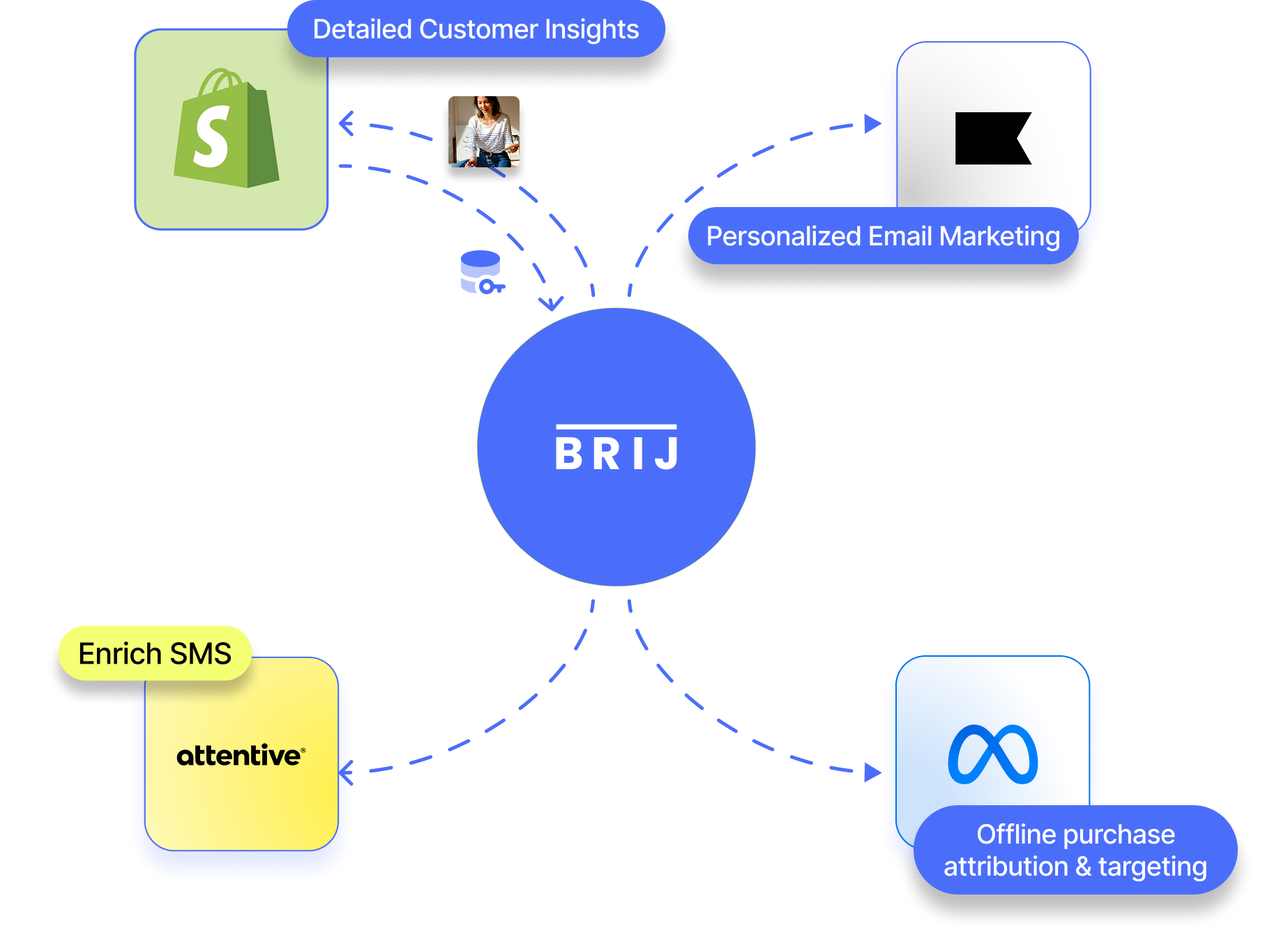
The first-party data captured through Brij does not live in a silo. Brij integrates seamlessly with Shopify, Klaviyo, and over 5,000 other marketing and ecommerce tools, automatically syncing customer profiles in real time.
This means a retail customer who scans a QR code on a product purchased at Costco can be instantly tagged in your Klaviyo account, enrolled in a welcome email flow, and tracked as they make future online purchases, without any manual work.
This connectivity also powers enhanced ad targeting. Brij automatically sends offline purchase events to platforms like Meta and Google, enabling brands to build more accurate lookalike audiences and retarget retail customers who would otherwise be invisible to their digital campaigns.
Own Your Relationships. Own Your Growth.
First-party data is the foundation of direct customer relationships. It powers personalization, enables accurate attribution, reduces dependence on paid acquisition, and ensures compliance in an increasingly privacy-conscious world.
For brands selling through retail and wholesale channels, the retail black box is no longer an unavoidable reality. With Brij, every product on every shelf becomes an opportunity to capture a first-party data point, start a direct conversation, and build a lasting customer relationship.
Stop renting your audience. Start owning your data.
References
[1]: https://www.uniformmarket.com/statistics/omnichannel-shopping-statistics
[2]: https://www.amraandelma.com/customer-acquisition-cost-statistics/
[3]: https://digitalmarketinginstitute.com/blog/why-first-party-data-is-more-important-than-ever-and-how-to-use-it
[4]: https://www.demandlocal.com/blog/privacy-compliance-marketing-statistics/
[5]: https://www.emarketer.com/content/faq-on-identity-resolution-navigating-privacy-cookies-cross-channel-fragmentation-2026
[6]: https://business.adobe.com/blog/generative-ai-powered-shopping-rises-with-traffic-to-retail-sites
[7]: https://www.mckinsey.com/capabilities/quantumblack/our-insights/the-automation-curve-in-agentic-commerce
[8]: https://www.attentive.com/press-releases/new-global-study-reveals-consumers-demand-more-personalization-in-marketing-81-ignore-irrelevant-messages-while-personalized-experiences-drive-loyalty-and-sales
[9]: https://marketingltb.com/blog/statistics/personalization-statistics/
[10]: https://www.cmswire.com/digital-marketing/first-party-data-the-benefits-and-challenges-for-marketers/
[11]: https://www.forbes.com/advisor/business/software/email-marketing-statistics-apr-26/