Table of Contents

Turning Receipts into Revenue: What Brands Can Actually Do with Receipt Data

- Physical receipts contain rich first-party data -- including retailer name and location, full basket composition, transaction details, and total order value -- that is typically invisible to brands selling through retail.
- Brij rebate campaigns create a value exchange that incentivizes shoppers to submit receipts at scale, transforming unknown retail buyers into known, contactable customers.
- AI-powered analysis of receipt data surfaces actionable intelligence across basket composition, geo and retailer context, and competitive brand presence.
- Receipt data can be piped directly into Klaviyo, Postscript, and Meta Ads to trigger targeted email, SMS, and paid media campaigns based on real offline purchase behavior.
For omnichannel brands selling through retail, the transaction has historically been the end of the line.
A shopper picks your product off the shelf, pays at the register, and walks out the door -- and you have no idea who they are, what else they bought, or whether they will ever come back.
That is the retail black box. You know your product is moving. You just do not know anything about the people moving it.
Physical receipts are a key to breaking that black box open. A receipt is not just a proof of purchase; it is a window into the full context of a shopping trip. When brands collect receipts at scale and analyze them with AI, they gain the kind of consumer intelligence that was previously available only to the retailers themselves.
This post breaks down exactly what data lives inside a receipt, how to collect it at scale, how to analyze it, and how to activate those insights to drive revenue.
What Data Lives in Receipts
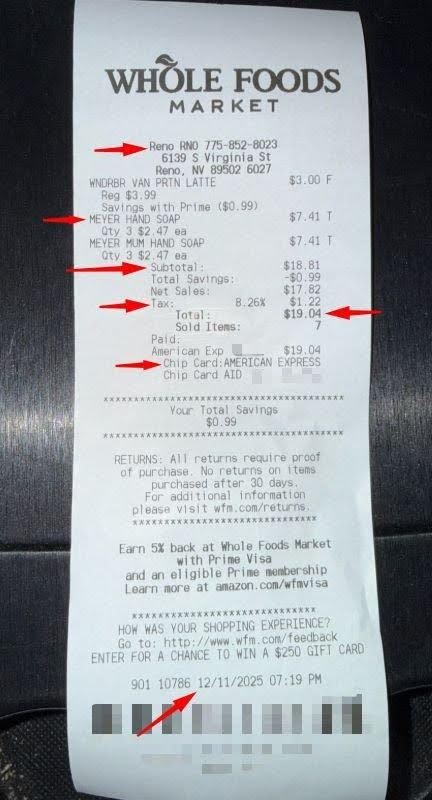
A standard retail receipt contains far more information than most brands realize. When Brij's receipt scanning technology processes a submitted receipt, it extracts a comprehensive set of structured data points from each transaction.
.png)
Taken together, these data points give brands a granular, real-world view of their buyers that no panel survey or third-party data provider can replicate. You are not looking at modeled behavior -- you are looking at actual purchase records.
The most underappreciated fields are basket composition and total basket AOV. Knowing what your customer bought on the same trip as your product tells you far more about who they are than any demographic segment ever could. And knowing the top brands and top categories being purchased alongside yours opens up entirely new possibilities for targeting, messaging, and partnership strategy.
How to Collect Receipt Data at Scale
The challenge has never been whether receipt data is valuable. The challenge has been acquiring it. Consumers will not share their receipts without a compelling reason to do so.
One way Brij solves this through digital rebate campaigns -- a value exchange that is straightforward for the consumer and extraordinarily data-rich for the brand.
A brand launches a rebate offer through Brij, promoted via on-pack QR codes, digital ads, email, or social media. A customer purchases the product, scans the QR code or clicks the link, opts in with their contact information, and submits a photo of their receipt. Brij's technology automatically scans and validates the receipt, and the customer receives their rebate -- typically via Venmo or PayPal -- within 48 hours.
The result is a frictionless experience for the shopper and a structured, AI-ready dataset for the brand. A single rebate campaign can generate thousands of verified receipts in a matter of weeks, turning a rebate budget into a first-party data asset that informs everything from creative strategy to retail expansion decisions.
The rebate is not just a discount mechanism. It is the mechanism that makes receipt data collection possible at scale.

How to Analyze Receipt Data with AI
Collecting receipts is only the beginning. The real value is in what you do with them. Bands can process receipt data to surface insights that are immediately actionable for marketing, sales, and strategy teams.
Basket Composition
Receipt data reveals what customers are buying alongside your product -- across every retailer and every market where you sell. This includes the specific items in the basket, the categories they belong to, and the brands they represent.
At scale, this data answers some of the most important questions a brand can ask:
- What are the top five categories being purchased with my product?
- What are the top five brands in my customers' baskets?
- How large is the average basket when my product is included, and how does that compare to my brand AOV alone?
These insights directly inform cross-sell strategy, bundling decisions, and creative positioning. They also reveal which adjacent categories your buyers are already shopping, pointing toward natural expansion opportunities.
Geo and Retailer Context
Because every receipt includes the retailer name and location, brands can analyze purchase patterns by city, state, and retail chain simultaneously. This goes well beyond standard sell-through reporting. Rather than knowing only that a product sold X units in a given region, brands can understand where their highest-value buyers are concentrated, which retailers are driving the most engagement, and how basket size varies by market.
Volume and value do not always align geographically. A market that generates fewer receipts may consistently produce higher basket totals -- meaning those buyers are worth significantly more per transaction. This kind of intelligence shifts marketing planning from "where should we spend?" to "where are people already showing high-value purchase intent?"
Competitive Brand Intelligence
Perhaps the most powerful insight that receipt data unlocks is a clear view of who else is in the basket. Because a receipt captures every item on the shopping trip, brands can see exactly which competitor and adjacent brands their customers chose on the same visit.
This reveals whether buyers are loyal to your segment or frequently purchasing direct competitors, which "better for you" or premium brands tend to travel alongside yours, and where co-marketing or bundling opportunities exist with adjacent brands that share your customer base.
Brands that identify these patterns first can move quickly to build partnerships, co-branded campaigns, or bundled retail promotions before competitors even know the opportunity exists.
How to Activate Receipt Data for Marketing
Insight without activation is just trivia. The final step is connecting receipt data directly to your marketing stack to trigger the right message to the right person at the right time.
Email and SMS Flows
Brij integrates natively with Klaviyo, Postscript, and more. When a receipt is approved, a structured event fires automatically into your email and SMS platforms, triggering a welcome flow built specifically for offline buyers -- people who have never interacted with your brand digitally before.
From there, the receipt data itself powers the segmentation. Brands can build audience segments based on retailer, basket size, purchase frequency, or the specific products bought alongside theirs, and route each contact into a nurture track that reflects their actual buying behavior. This is not generic email marketing -- it is personalized, behavior-driven communication triggered by what someone actually bought at a physical retail store.
Meta Ads
Receipt data fundamentally changes what is possible with Meta advertising. Without it, brands selling through retail can only send D2C buyer data to Meta, leaving the majority of their actual customer base invisible to the algorithm. With Brij, brands can send both D2C and retail buyer data to Meta, creating a richer, more representative audience for Meta to optimize against.
Brij enables three specific Meta activation strategies.
- First, sending "Receipt Approved" events to Meta as custom events allows brands to attribute actual offline retail purchases back to specific ad campaigns -- data that would otherwise be completely invisible.
- Second, receipt-verified buyers can be used to build lookalike audiences, since verified purchasers represent a far higher-quality signal than website visitors or email openers alone.
- Third, by sending receipt events as offline purchases, brands unlock Meta's Omnichannel Ads product, which, with Brij, can now drive offline conversions (as well as online) simultaneously, and close the loop between digital advertising and physical retail.
The Receipt Is Just the Beginning
Every receipt a customer submits is more than a rebate claim. It is a first-party data asset, a customer profile, a competitive intelligence report, and a marketing trigger -- all in one.
Brands that treat receipt data as a strategic resource will build a compounding advantage: better audience data leads to better targeting, which leads to more efficient acquisition, which leads to more receipts, which leads to better data. The loop is self-reinforcing.
If you are running rebate campaigns and not analyzing your receipt data, you are leaving the most valuable part of the program on the table. And if you are not running rebate campaigns yet, there has never been a better time to start.
Ready to turn your receipts into revenue? Book a demo with Brij today.