Table of Contents

How to Drive Foot Traffic to Retail (and Know Who Bought)

- Gen Z is driving a resurgence in physical retail, with mall foot traffic up 57% year-over-year according to PwC.
- Driving foot traffic to retail without a data capture strategy is a missed opportunity: brands that rely on broad tactics like generic digital ads or out-of-home advertising move units but remain blind to who their customers actually are.
- Brands can use Brij to power digital campaigns, influencer pushes, pop-up activations, and loyalty incentives that direct shoppers to specific retailers while capturing verified first-party data in the process.
- Every Brij-powered campaign turns anonymous retail transactions into known CRM contacts, bridging the gap between online discovery and in-store purchase.
- Whether launching in a new retailer or boosting velocity in an existing one, brands that can demonstrate verified in-store sales gain a meaningful edge in buyer conversations, securing better shelf placement over time.
For omnichannel brands, retail shelves represent massive scale and revenue potential. But they also present one of the most frustrating challenges in modern marketing: retail is a black box.
You know your products are moving at Target, Walmart, Whole Foods, or specialty retailers, but you don’t know who is buying them. You can't tell if a recent social media campaign drove a specific in-store purchase, and you certainly can't follow up with that shopper to build a long-term relationship.
Historically, driving foot traffic to retail meant relying on broad, hard-to-measure tactics like out-of-home advertising or generic digital ads, hoping the halo effect would translate to register scans.
Today, the landscape has shifted. The most successful brands are using targeted, trackable strategies to send high-intent shoppers to specific retailers, and capturing invaluable first-party data in the process.
Why Driving Retail Foot Traffic Matters Today
Contrary to the narrative that younger consumers only shop online, Gen Z is actually leading a resurgence in physical retail. Recent data shows that Gen Z's share of mall foot traffic grew 57% year-over-year, according to PwC [1].
Furthermore, 61% of Gen Z consumers now prefer to discover new products in-store, and 43% expect to use social media to discover products before transitioning to a physical store to make the purchase [1].
This "discover online, buy in-store" behavior represents a massive opportunity. When you can successfully bridge the gap between digital discovery and physical retail, you unlock several key advantages:
1. Accelerated Retail Velocity
Retailers allocate shelf space based on sales performance. Products that move quickly earn better placement, more facings, and increased promotional support. By actively driving traffic to specific retailers, you prove your value as a partner and secure your position on the shelf.
2. Stronger Retailer Relationships
When you can walk into a buyer meeting and say, "We ran a campaign that drove 10,000 verified purchases at your stores last month," you change the dynamic of the relationship. You are no longer just a vendor; you are a growth driver.
3. Capturing the Omnichannel Shopper
Consumers who shop across multiple channels are consistently more valuable than single-channel shoppers. By encouraging online audiences to purchase in-store, you create stickier, more profitable customer habits.
Two Main Use Cases for Driving Retail Traffic
When brands look to drive foot traffic, it typically boils down to one of two core scenarios:
- "I launched in a new retailer and need to show them I can sell a lot." You have a limited window to prove your velocity and secure your spot on the shelf. You need an immediate, targeted spike in traffic to that specific retailer.
- "I'm already in a retailer, but not selling enough." You are at risk of losing facings or being discontinued. You need to re-engage your audience and drive them to the store to boost your numbers.
The Challenges of Driving (and Tracking) In-Store Traffic
While the benefits are clear, the execution is notoriously difficult. Brands face several significant hurdles when trying to influence and track offline behavior:
The Omnichannel Attribution Gap
When a customer sees your TikTok ad and subsequently buys your product at Whole Foods, your digital ad platform claims zero credit. This disconnect makes it incredibly difficult to calculate Return on Ad Spend (ROAS) for campaigns designed to drive retail velocity.
The Black Box of Retail Data
When the majority of your sales happen through retail partners and third-party channels rather than your own website, you're operating without direct visibility into who your customers are. Retailers own the transaction data, leaving brands with no direct line of communication to the end consumer. You can't ask them for a review, offer them a complementary product, or enroll them in a loyalty program.
Friction at the Point of Sale
Traditional methods of driving in-store purchases, like paper coupons or complex rebate mail-ins, create friction for the consumer. If the redemption process is too difficult, shoppers simply won't bother, rendering the campaign ineffective.
6 Ways to Drive Foot Traffic and Capture Data with Brij
To solve these challenges, brands need strategies that incentivize in-store purchases while simultaneously capturing customer information. This is where Brij transforms retail purchases into data-rich marketing opportunities.
By leveraging Brij's platform, brands can deploy several highly effective, measurable strategies to drive foot traffic:
1. Digital Awareness Campaigns
Brands can run targeted digital awareness ads that explicitly drive people to specific stores. For example, "Go get Health-Ade in the closest Whole Foods near you."
To make these campaigns measurable and drive higher conversion, brands can layer a Brij rebate or sweepstakes directly onto that digital offer. When the customer buys in-store and uploads their receipt, you close the loop on your ad spend and capture their contact information in the process.
2. Influencer Campaigns
Influencers are powerful drivers of retail velocity. When a brand launches in a new retailer, for example, they can have an influencer talk about the launch and push their followers to the store to buy.
By equipping that influencer with a Brij-powered, retailer-specific rebate link (say, a Target-exclusive offer) you give the audience a clear incentive to engage, and you can precisely measure how many in-store sales that influencer actually drove.
3. Pop-Up Activations
In-person experiential marketing is a highly effective way to drive immediate foot traffic. Imagine setting up a branded truck or booth outside of a Target or Whole Foods with a "sip and shop" activation.
You drive trial and can use Brij QR codes at the pop-up to offer an immediate digital rebate or store-exclusive deal when they walk inside and purchase your product, capturing their data before they even leave the parking lot.
4. Loyalty Incentives
You can also tie retail purchases directly to your brand's loyalty program to create a retailer-specific incentive without running a full rebate campaign.
With Brij, you can offer incentives like, "Send us a receipt showing you bought our product at Whole Foods, and we'll give you account points," or "Buy XYZ at Whole Foods and get a free gift on us." Shoppers upload their receipt, Brij verifies the purchase, and you reward them automatically, all while adding a verified, known customer to your CRM.
5. Digital Rebates
Digital rebates create a direct, measurable path from online engagement to in-store purchase. They work because they are fast, familiar, and mobile-first. With Brij, you can spin up SMS-based or email-based rebate campaigns in days to support new retail launches or boost velocity at a specific retailer. For example, a "Buy One, Get One Free" offer.
The magic happens in the execution. Shoppers simply upload a photo of their receipt via a Brij-powered link. Brij's AI-powered receipt analysis verifies the retailer, purchase date, line items, and quantity in seconds. In exchange, customers provide their contact information, turning an anonymous retail transaction into a known CRM contact.
Real-World Example: Looner
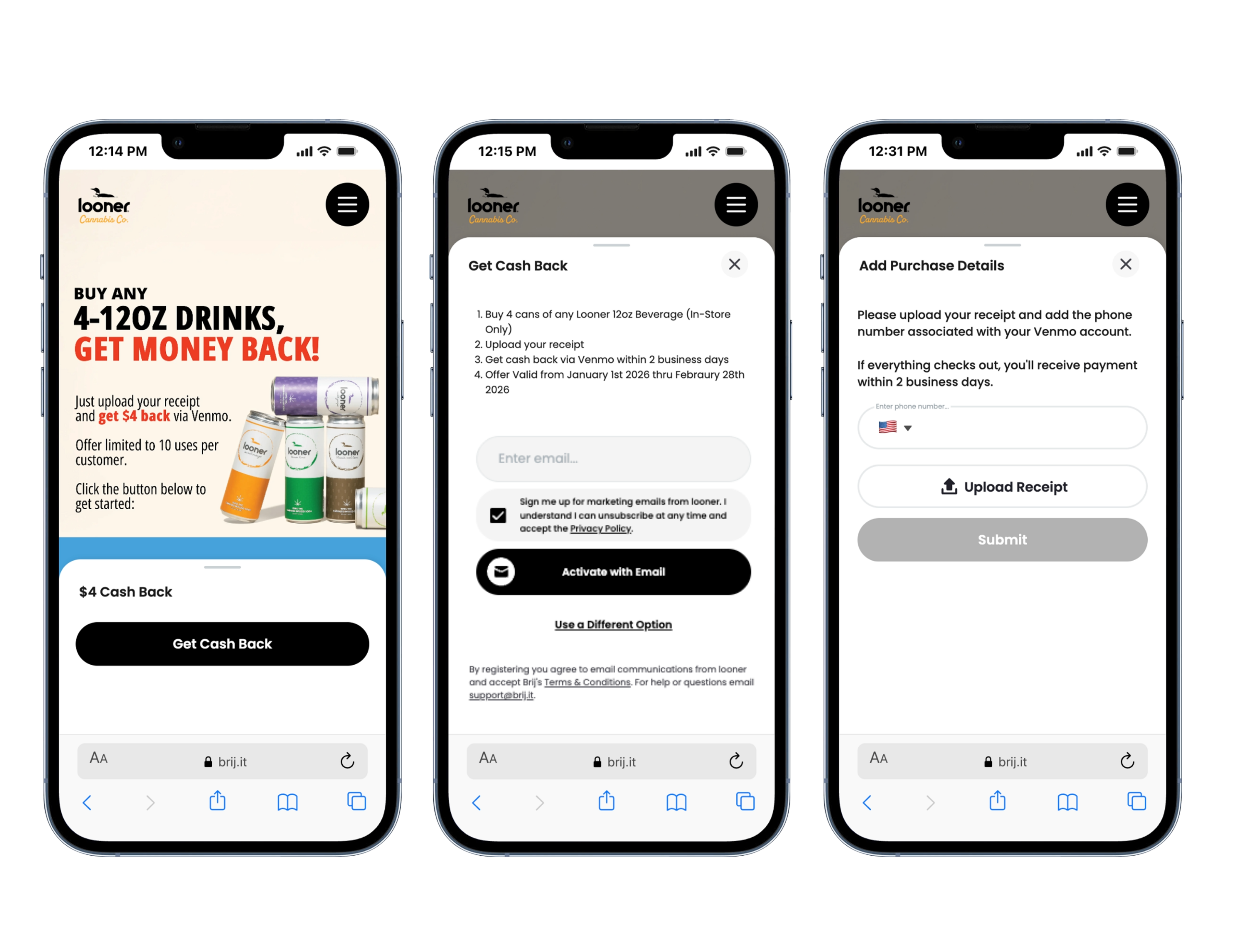
Looner, a cannabis-infused beverage brand, needed to drive in-store velocity across Midwest retail accounts while capturing first-party data in a highly regulated category. Because they could not rely on traditional digital media spend or SMS, they partnered with Brij to launch an email-first digital rebate: "Buy one 4-pack, get $4 back."
Brij navigated the complex THC compliance restrictions and powered the entire flow. Consumers scanned in-store POS posters or fridge clings, submitted proof of purchase, and completed the rebate via email capture.
The results were immediate: an 82% submission rate, a 29% initiation rate, and significant growth in first-party email capture, all while driving ongoing traffic lift across participating retailers.
6. Sweepstakes
Sweepstakes offer a natural value exchange: customers willingly share their information and proof of purchase in exchange for a chance to win something meaningful. A well-executed sweepstakes campaign requiring proof of purchase from a specific retailer creates immediate incentives that translate directly to increased sales velocity.
Brij manages the official rules, eligibility, and state regulations to ensure compliance. Entries are instantly validated via the same AI receipt scanning technology, ensuring only genuine purchases are counted, and every entrant becomes part of your owned audience, ready for lifecycle marketing and retargeting.
Real-World Example: Chamberlain Coffee
Chamberlain Coffee, founded by creator Emma Chamberlain, wanted to boost foot traffic to retailers and incentivize in-store purchases while collecting first-party data for remarketing. They partnered with Brij to launch a nationwide sweepstakes offering a chance to meet Emma Chamberlain and have her personally redesign the winner's coffee corner.
Chamberlain Coffee placed QR codes on in-store end caps and floor displays, and pushed the link through their social channels. Customers who purchased from any retailer could scan the code and upload their receipt via Brij. Brij managed the entire sweepstakes process, from drafting rules and bonding to winner selection and tax compliance.
Over a two-month campaign, the Brij-powered sweepstakes drove over 750 in-store transactions, generated 36,000 engagements, and captured more than 9,000 emails with an impressive 24% scan-to-registration conversion rate. Crucially, the campaign enhanced Chamberlain Coffee's retail relationships, leading to improved shelf placement and in-store signage.

The True Value: Turning Foot Traffic into First-Party Data
Driving foot traffic increases volume and revenue in the short term, but the long-term value lies in the data.
When you use Brij to drive shoppers to retail via sweepstakes, rebates, digital campaigns, influencers, or pop-ups, you aren't just moving units; you are acquiring first-party data. You now know exactly who bought your product, where they bought it, and what else was in their basket.
This data flows directly into your CRM, allowing you to:
- Build Relationships: Follow up with retail buyers to request reviews, offer educational content, or cross-sell other products.
- Optimize Marketing: Use purchase data to build lookalike audiences for digital ads, closing the loop on omnichannel attribution.
- Win at Retail: Leverage basket-level insights and velocity data in your next buyer meeting to prove your brand's impact and secure better placement.
In an era where customer acquisition costs are rising and third-party data is disappearing, the brands that win will be the ones that can successfully bridge the digital and physical worlds. By driving targeted foot traffic and capturing the data behind every scan, you can turn the retail black box into your most powerful growth engine.
References
[1] PwC. "The Gen Z paradox: Spending less, expecting more." (October 2025) https://www.pwc.com/us/en/industries/consumer-markets/library/gen-z-consumer-trends.html